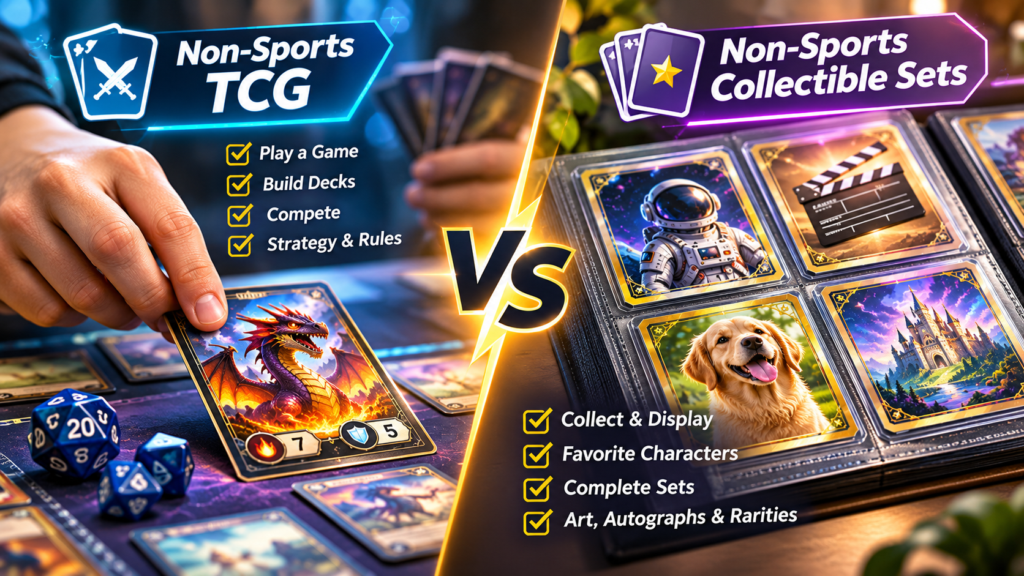
Non-Sports TCG vs. Collectible Sets: Key Differences
Differences Between Non-Sports TCG vs. Non-Sports Collectible Sets: A Complete Beginner’s Guide (2026)
Published by NCASE CARDS | November 2026
Publisher disclosure: This article is published by NCASE CARDS, a company specializing in premium personalized trading cards and collectible products. We discuss trading card games, entertainment collectibles, and custom trading cards to help readers understand the hobby. NCASE is not affiliated with the third-party franchises mentioned in this guide.
What’s the Difference Between a Non-Sports TCG and a Non-Sports Collectible Card Set?
Quick Answer: The biggest difference between a non-sports trading card game (TCG) and a non-sports collectible card set is the card’s primary purpose.
A trading card game is designed around gameplay. Players build decks, follow rules, and use cards with specific abilities or effects to compete against opponents.
A non-sports collectible card set is primarily designed for collecting, displaying, trading, and appreciating artwork, characters, entertainment properties, or meaningful subjects. The cards generally do not need to function within a structured game.
Popular TCGs include Pokémon, Magic: The Gathering, Yu-Gi-Oh!, and Disney Lorcana.
Examples of non-sports collectible sets include movie trading cards, television series collectibles, character cards, historical card sets, and premium personalized trading cards.
Both categories can feature beautiful artwork, rare inserts, holographic finishes, limited print runs, and passionate collector communities.
However, the reasons people buy, trade, preserve, and value these cards can be very different.
Understanding those differences can help you decide which type of trading card collection is right for you.
Non-Sports TCG vs. Non-Sports Collectible Sets: Side-by-Side Comparison
| Feature | Non-Sports TCG | Non-Sports Collectible Set |
|---|---|---|
| Primary purpose | Gameplay and collecting | Collecting and display |
| Structured gameplay | Yes | Usually no |
| Card abilities | Often include attacks, effects, or costs | Usually descriptive or visual |
| Deck building | Common | Generally unnecessary |
| Official rules | Yes | Usually not |
| Competitive tournaments | Often available | Generally not applicable |
| Collectible rarity | Common | Common |
| Special finishes | Often available | Often available |
| Autograph cards | Less central to gameplay | Common in some entertainment sets |
| Value drivers | Gameplay, rarity, condition, demand | Subject, rarity, condition, demand |
| Customization | Limited in official competitive formats | Common in personalized products |
| Best for | Players and collectors | Collectors, fans, and gift buyers |
Key takeaway: TCG cards are designed to participate in a game. Collectible cards are designed primarily to be collected.
That does not mean TCG cards cannot be collected without being played. Many people collect Pokémon or Magic cards exclusively for their artwork, rarity, or nostalgia.
The categories overlap, but their underlying product designs are different.
What Is a Non-Sports Trading Card Game?
A non-sports trading card game is a structured game in which players use collectible cards as game pieces.
Each card may represent a character, creature, spell, object, location, or special ability.
Cards interact according to a defined rule system.
Players often construct decks from their collections and compete in matches.
Common Characteristics of TCG Cards
Most TCGs include some combination of:
- Rules governing gameplay.
- Deck construction requirements.
- Card abilities or effects.
- Resources or costs for playing cards.
- Turn-based interaction.
- Win and loss conditions.
- Different card rarities.
- New expansions and product releases.
The exact mechanics vary from game to game.
Popular Examples of Non-Sports TCGs
Pokémon Trading Card Game
The Pokémon Trading Card Game uses Pokémon, Trainer, and Energy cards.
Players build decks and compete using a defined system of attacks, abilities, and game objectives.
Pokémon cards are also widely collected by people who never participate in gameplay.
Official website: https://tcg.pokemon.com/
Magic: The Gathering
Magic: The Gathering is a fantasy-themed trading card game centered on spells, creatures, strategies, and different gameplay formats.
Its cards can be used in casual games, organized play, and competitive events.
Magic also has a substantial collector market for older releases, alternate artwork, and scarce cards.
Official website: https://magic.wizards.com/
Yu-Gi-Oh! Trading Card Game
Yu-Gi-Oh! features monsters, spells, traps, and strategic dueling.
The game has an established organized-play community, and collectors also pursue rare and nostalgic cards.
Official website: https://www.yugioh-card.com/
Disney Lorcana
Disney Lorcana is a collectible trading card game featuring Disney characters and a distinct gameplay system.
Its appeal includes both playing the game and collecting character artwork.
Official website: https://www.disneylorcana.com/
Why People Collect TCG Cards
Not everyone who purchases TCG cards wants to play competitively.
Collectors may focus on:
- Favorite characters.
- Beautiful illustrations.
- Rare alternate artwork.
- First or early releases.
- Complete expansions.
- High-grade examples.
- Nostalgic cards.
- Specific artists.
This is one reason the line between TCGs and traditional collectibles can sometimes appear blurred.
What Is a Non-Sports Collectible Card Set?
A non-sports collectible card set is a collection of trading cards primarily intended to be owned, organized, traded, appreciated, or displayed rather than used as components of a formal game.
These cards often feature entertainment properties, original artwork, celebrities, historical subjects, animals, or personalized content.
Common Characteristics of Collectible Sets
Non-sports collectible sets may include:
- Numbered base cards.
- Character profiles.
- Artwork cards.
- Behind-the-scenes photographs.
- Special inserts.
- Autographs.
- Memorabilia cards.
- Foil or holographic finishes.
- Limited-print parallels.
- Complete-set checklists.
Unlike a TCG, a collectible set generally does not require players to understand rules or build decks.
The collecting experience is the primary activity.
Popular Types of Non-Sports Collectible Sets
Movie Trading Cards
Movie trading cards celebrate films, characters, memorable scenes, costumes, and production artwork.
Some releases include autograph or memorabilia inserts.
Television Trading Cards
Television card sets may feature cast members, episodes, characters, and behind-the-scenes material.
Collectors often pursue favorite shows or complete seasonal sets.
Comic Book and Superhero Cards
Comic-themed collectibles highlight characters, original illustrations, storylines, and artist interpretations.
Some products emphasize premium artwork and special inserts.
Anime and Animation Cards
Anime-inspired collectible sets may feature characters, scenes, original illustrations, and special finishes.
Not every anime-themed card product is a TCG.
Historical and Educational Cards
Non-sports collecting also includes cards celebrating historical events, scientific discoveries, cultural figures, and educational subjects.
Personalized Trading Cards
Personalized cards allow individuals to create collectible-style products featuring their own photographs, names, achievements, characters, or stories.
They may resemble traditional trading cards in size and presentation without belonging to an established game.
This is the category in which NCASE CARDS specializes.
7 Major Differences Between TCGs and Non-Sports Collectible Sets
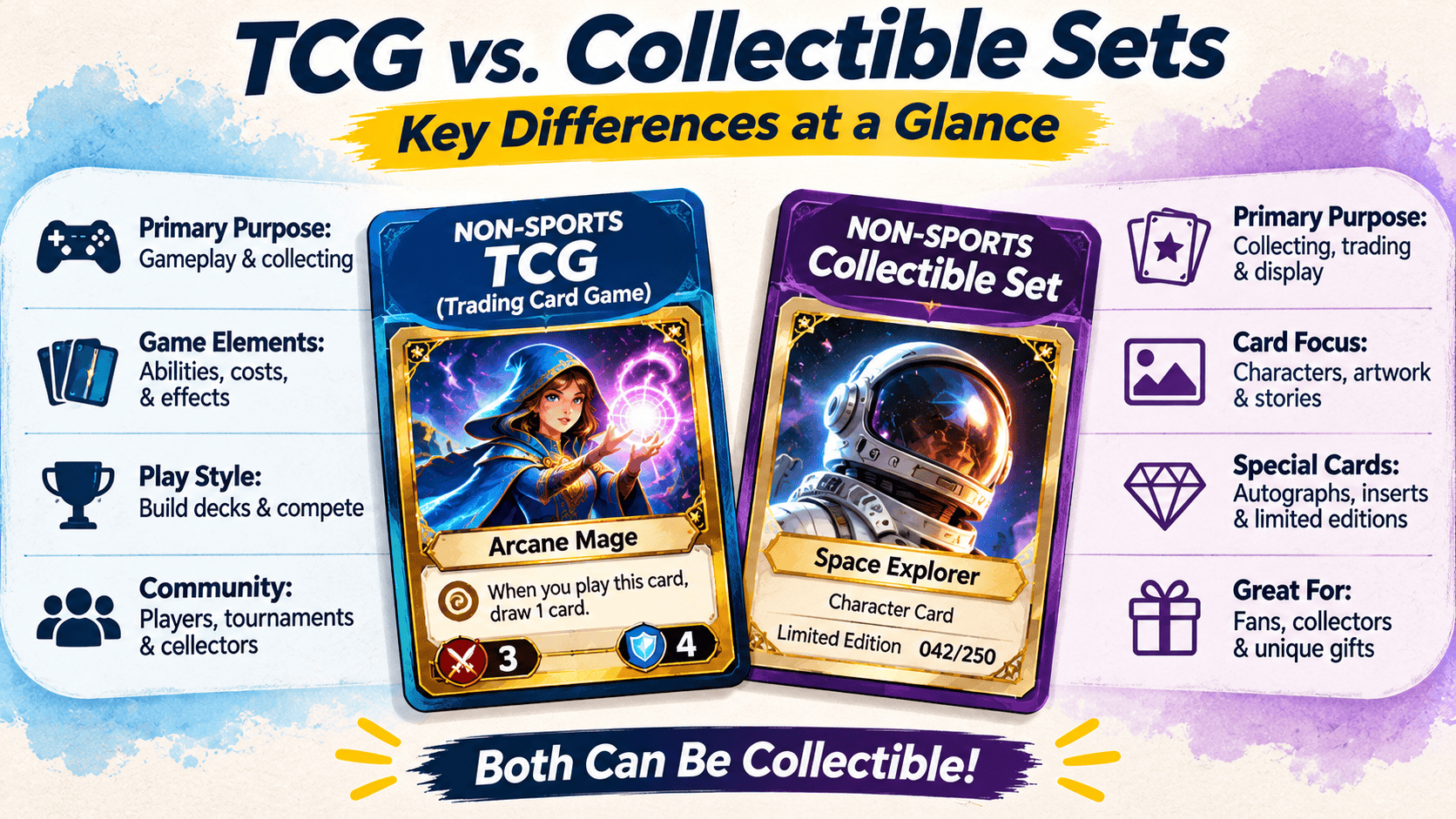
1. Gameplay vs. Collecting
The most important difference is how the cards are intended to be used.
In a TCG, cards have defined roles within a game.
A card may allow a player to attack, defend, generate resources, or trigger a particular effect.
In a collectible set, the card itself is the object of interest.
Collectors may appreciate its artwork, subject, rarity, or sentimental meaning.
Example:
A fantasy dragon card in a TCG might have an attack value, a resource cost, and a special ability.
A fantasy dragon card in a collectible art set might feature a detailed illustration, artist information, and a limited-edition number.
Both cards can be collectible.
Only the first necessarily participates in a formal game.
2. Rules and Deck Building
TCGs generally require players to learn rules.
Depending on the game, players may need to understand:
- Deck sizes.
- Card limits.
- Turn sequences.
- Resource systems.
- Winning conditions.
- Format restrictions.
- Banned or restricted cards.
Collectible card sets generally have no comparable requirements.
A collector can purchase a card, place it in a protective holder, and enjoy it immediately.
This makes traditional collectible sets approachable for people who are interested in cards but not in learning a game.
3. Card Design and Information
TCG cards must communicate gameplay information clearly.
That information may include attacks, abilities, costs, effects, or other mechanical details.
Collectible cards have greater flexibility in how they present information.
A movie collectible might include a character biography.
An artist card might emphasize illustration.
A personalized athlete card might feature a name, photograph, jersey number, and accomplishments.
The design is driven by the story being told rather than by the needs of a competitive game.
4. Rarity and Scarcity
Both TCGs and collectible sets can contain rare cards.
However, rarity may be structured differently.
Rarity in TCGs
TCG rarity can be communicated through:
- Rarity symbols.
- Alternate artwork.
- Special foil treatments.
- Promotional distribution.
- Product-specific pull rates.
- Limited release opportunities.
A card may be desirable because it is rare, playable, visually appealing, or associated with a popular character.
Rarity in Collectible Sets
Traditional collectible sets may feature:
- Numbered parallels.
- Limited print runs.
- Autograph inserts.
- Memorabilia cards.
- Exclusive promotional cards.
- Artist sketches.
- Special printing treatments.
A card marked “25/100” generally indicates an individually numbered card within a stated edition of 100, assuming the manufacturer’s numbering is authentic.
A custom card is not automatically a limited edition simply because only one copy was ordered.
Important distinction: Personalization, rarity, and limited-edition numbering are different product characteristics.
5. How Card Values Are Determined
TCG and non-sports collectible card values depend on many overlapping factors.
However, the relative importance of those factors can differ.
TCG Value Drivers
- Competitive usefulness.
- Character popularity.
- Collector demand.
- Rarity.
- Card condition.
- Edition or release.
- Tournament legality.
- Artwork.
- Market supply.
Collectible Set Value Drivers
- Entertainment franchise popularity.
- Subject or character.
- Autographs.
- Scarcity.
- Historical importance.
- Condition.
- Set completeness.
- Artist reputation.
- Collector demand.
Not every card is an investment.
Many cards are purchased primarily for enjoyment.
Personalized trading cards can also carry emotional value that is unrelated to their resale market.
6. Community and Collector Experience
TCGs often have two overlapping communities: players and collectors.
Players may attend local game stores, tournaments, and organized-play events.
Collectors may focus on completing sets, finding rare cards, or preserving valuable examples.
Traditional non-sports collectible communities are more likely to center on:
- Collector conventions.
- Online trading groups.
- Entertainment fandoms.
- Set-building.
- Artist communities.
- Autograph collecting.
- Display and preservation.
Neither approach is inherently better.
They simply offer different ways to participate in the hobby.
7. Customization and Personalization
This is one of the most significant differences for collectors who want something uniquely their own.
Official TCG cards generally must comply with the rules of their respective games.
A fan-designed card cannot automatically be used in an official tournament.
Traditional collectible cards are not bound by gameplay requirements.
That opens the door to personalized artwork, custom photographs, original characters, and meaningful personal stories.
A custom collectible can celebrate a person, pet, achievement, or event without needing to function as a game piece.
Can a Trading Card Be Both a TCG Card and a Collectible?
Absolutely.
In fact, many of the most recognizable trading cards belong to both worlds.
A Pokémon card can be a playable game piece and a valuable collector’s item.
A Magic: The Gathering card can be useful in a deck while also being desirable because of its artwork or rarity.
A Yu-Gi-Oh! card can have competitive importance and nostalgic appeal.
The distinction concerns the product’s intended function, not whether people are allowed to collect it.
A card does not stop being a TCG card simply because its owner never plays the game.
Similarly, a collectible card does not become part of an official TCG merely because it contains fictional abilities or statistics.
Which Is Better for Beginners: TCGs or Collectible Card Sets?
The better choice depends on what you want from the hobby.
| If You Enjoy… | Consider… |
|---|---|
| Strategy and competition | TCGs |
| Building decks | TCGs |
| Organized tournaments | TCGs |
| Favorite movie or television characters | Entertainment collectible sets |
| Completing numbered sets | Traditional collectible sets |
| Original artwork | Artist and illustration card sets |
| Personalized gifts | Custom collectible cards |
| Preserving family memories | Personalized trading cards |
| Collecting without learning game rules | Non-sports collectible sets |
Choose a TCG If You Want to Play
A TCG can provide a combination of strategy, social interaction, collecting, and ongoing discovery.
Starter products can help beginners learn the rules before purchasing larger quantities of cards.
Choose Collectible Sets If You Love the Subject
Entertainment and character card sets can be especially appealing when you already have a favorite franchise, artist, or theme.
You can enjoy collecting without needing to learn a gameplay system.
Choose Personalized Cards If You Want Something Unique
Personalized trading cards are ideal for turning an original photograph, character, or meaningful moment into a physical collectible.
Their appeal is not necessarily tied to gameplay or resale value.
How Much Does It Cost to Start Collecting?
The cost of entry varies widely across both categories.
TCG products may include starter decks, booster packs, preconstructed decks, and boxed collections.
Traditional non-sports collectible products may include individual cards, sealed packs, complete sets, and premium inserts.
Personalized trading cards are often purchased as individual custom products or coordinated sets.
Beginner Budget Example
A hypothetical $50 collecting budget could be allocated differently depending on your goals.
| Collecting Approach | Example Budget Allocation |
|---|---|
| TCG beginner | $25 starter product + $25 additional cards |
| Entertainment collector | $30 base set + $20 selected singles |
| Art card collector | $35 artist cards + $15 storage supplies |
| Personalized collector | Custom card purchase + appropriate protective display within budget |
These are illustrative allocations, not current product prices.
Beginner tip: Set a spending limit before purchasing packs or chasing rare inserts. Buying specific singles can be more predictable than relying on randomized packs.
Are Non-Sports Collectible Cards Worth Money?
Some are.
But not every non-sports collectible has an established resale market.
A card’s value depends on demand, condition, scarcity, authenticity, and comparable sales.
A rare entertainment autograph may attract significant collector interest.
A common card from the same release may have little resale demand.
The same principle applies to TCGs.
A powerful or rare card can be desirable, but popularity and prices change.
Personal Value vs. Market Value
A personalized trading card featuring your child, pet, or original character may have limited resale demand.
Yet it can be extremely meaningful to the person who owns it.
That distinction matters.
Collectible value is not always financial value.
Sometimes the most important card in a collection is the one that tells a personal story.
Can Non-Sports TCG and Collectible Cards Be Graded?
Many can, subject to the grading company’s eligibility requirements.
Professional card grading services such as PSA, CGC Cards, and Beckett evaluate eligible trading cards for authenticity and condition.
Both gaming cards and traditional non-sports collectibles may qualify.
However, privately produced or personalized cards are not automatically eligible.
Always verify acceptance before submitting.
Is Grading Necessary?
No.
Professional grading can be useful for authentication, condition documentation, or resale.
But collectors can also protect cards using:
- Soft sleeves.
- Rigid toploaders.
- Card binders.
- Magnetic holders.
- Protective acrylic cases.
A premium protective case is not equivalent to third-party authentication or numerical grading.
For many personalized collectibles, display and preservation are more relevant than professional grading.
Where Does NCASE CARDS Fit Into the Non-Sports Card Market?
NCASE CARDS specializes in premium personalized trading cards and collectible presentation.
Rather than producing a traditional competitive TCG, NCASE allows customers to turn their own photographs, stories, and achievements into physical trading cards.
The company’s broader philosophy is simple:
Everyone Deserves Their Own Trading Card.
What Makes Personalized Trading Cards Different?
Most traditional collectible products celebrate existing characters, celebrities, entertainment properties, or established franchises.
Personalized cards put the customer at the center of the experience.
Instead of collecting someone else’s story, you can create a card that celebrates your own.
Examples include:
Youth Sports Trading Cards
Turn an athlete’s photograph, name, jersey number, and accomplishments into a personalized keepsake.
Pet Trading Cards
Celebrate a favorite dog, cat, or other pet with a collectible card featuring its personality and photograph.
Original Character Cards
Create a card featuring an original fantasy character, illustration, or creative concept.
Commemorative Cards
Celebrate birthdays, graduations, championships, family milestones, or other meaningful events.
Team and Group Sets
Create coordinated cards featuring athletes, teams, organizations, or groups.
Premium Collectible Presentation
NCASE emphasizes physical quality and presentation, with options that may include premium card stock, holographic effects, and protective display products.
These features can make personalized cards feel like meaningful collectibles rather than disposable novelty items.
However, they do not make the cards official game pieces, independently graded collectibles, or automatically scarce editions.
Are NCASE Cards Official TCG Cards?
No.
Personalized NCASE trading cards are not automatically legal for competitive play in Pokémon, Magic: The Gathering, Yu-Gi-Oh!, Disney Lorcana, or other third-party games.
Original fantasy-style cards may borrow general design concepts from collectible gaming, but they should not be represented as officially licensed or tournament-approved products.
NCASE’s core value is in creating and preserving personalized collectible experiences.
Can You Create Your Own Non-Sports Collectible Card Set?
Yes.
Creating an original collectible card set can be a rewarding project for artists, families, teams, businesses, and hobby enthusiasts.
Unlike an official competitive TCG, a collectible set does not necessarily require a complex gameplay system.
Step 1: Choose a Theme
Possible themes include:
- Original fantasy characters.
- Family memories.
- Pets.
- School achievements.
- Local history.
- Artwork.
- Team members.
- Community events.
Step 2: Decide How Many Cards to Include
A small set might include five or ten cards.
A larger project might feature dozens of subjects.
The ideal number depends on the project’s purpose and budget.
Step 3: Establish a Consistent Design
Choose coordinated fonts, borders, colors, and information fields.
A consistent design helps the cards feel like part of a unified collection.
Step 4: Add Meaningful Information
Include character descriptions, photographs, names, statistics, achievements, or short stories.
Step 5: Select Materials and Finishes
Consider card thickness, print quality, holographic effects, and protective options.
Step 6: Plan How the Cards Will Be Shared
You might distribute cards as gifts, keepsakes, promotional items, or coordinated sets.
Step 7: Protect the Finished Collection
Use suitable storage or display products to help preserve the cards.
If you want to claim that a set is limited to a specific number of copies, establish and document the production quantity accurately.
What About Original Fantasy Cards With Game-Like Statistics?
These products occupy an interesting middle ground.
A fantasy character card may feature attributes such as strength, speed, intelligence, or special abilities.
That can make it resemble a TCG card.
However, unless those statistics operate within a defined game system, the card is better described as a fantasy-style collectible.
Example
Imagine an original dragon card featuring:
Character: Emberwing
Strength: 95
Speed: 82
Special Ability: Flame Shield
If those attributes are simply part of the character’s presentation, the product is a collectible card.
If they function within a consistent rule system that determines gameplay outcomes, the card may be part of an original game.
The difference lies in how the cards are designed and used.
Common Mistakes Beginners Make
Assuming Every Trading Card Is a Game Card
Many trading cards are created exclusively for collecting.
Assuming Every TCG Card Must Be Played
TCG cards can also be collected for their artwork, rarity, or nostalgia.
Confusing Holographic Finishes With Rarity
A holographic finish is a printing or design characteristic. It does not automatically establish scarcity.
Assuming Custom Cards Are Officially Licensed
A personalized card is not automatically affiliated with the franchise or game it resembles.
Treating Asking Prices as Market Value
Use actual completed sales when evaluating resale value.
Assuming All Cards Can Be Professionally Graded
Grading companies have eligibility requirements and may reject certain custom products.
Spending Too Much on Randomized Packs
Set a budget and consider purchasing specific cards rather than relying entirely on chance.
Frequently Asked Questions
What does TCG stand for?
TCG stands for Trading Card Game, a game that uses collectible cards as gameplay components.
Are Pokémon cards considered non-sports cards?
Yes. Pokémon cards are generally classified as non-sports trading cards and are also part of a structured trading card game.
Are all non-sports trading cards TCG cards?
No. Many non-sports trading cards are intended primarily for collecting and do not have gameplay rules.
What is the difference between a TCG and a collectible card set?
A TCG is designed around gameplay, while a collectible card set is primarily intended for collecting, trading, and display.
Can you collect TCG cards without playing?
Yes. Many collectors focus on artwork, rarity, characters, or complete sets without playing the game.
Are movie trading cards considered TCG cards?
Usually not. Most movie trading cards are entertainment collectibles, although some movie franchises also have separate trading card games.
Are Marvel trading cards a TCG?
Some Marvel-themed products are traditional collectible cards, while others are designed as games. The classification depends on the specific product.
Are Disney Lorcana cards collectible or playable?
Both. Disney Lorcana is a TCG, but its cards can also be collected for their artwork and character appeal.
Are holographic cards always rare?
No. Holographic finishes do not automatically indicate a limited print run or high market value.
Can collectible card sets include autographs?
Yes. Many entertainment card releases include autograph cards or other special inserts.
Can custom trading cards have statistics?
Yes. Personalized cards can feature statistics, attributes, biographies, or other information without being part of a formal game.
Can you create your own TCG?
Yes. Creating an original TCG involves designing rules, balancing gameplay, developing cards, and testing the game.
Can you create collectible cards without gameplay rules?
Absolutely. Many custom card sets are designed purely for collecting, display, or gifting.
Are personalized trading cards valuable?
They may have sentimental value even when they do not have an established resale market.
Can custom trading cards be professionally graded?
Eligibility varies by grading company. Privately produced or unlicensed cards may not qualify.
Are NCASE CARDS official Pokémon or Magic cards?
No. NCASE creates personalized collectible products and does not automatically produce officially licensed or tournament-legal cards for third-party games.
Which is better for children: TCGs or collectible sets?
Both can be enjoyable. TCGs may appeal to children interested in strategy and gameplay, while collectible sets may appeal to those who enjoy artwork, favorite characters, or personalized keepsakes. Product age guidance should be considered.
What is the best way to start collecting non-sports cards?
Choose a subject or game you genuinely enjoy, set a budget, learn the basics, and use appropriate storage materials.
Final Verdict: TCGs vs. Non-Sports Collectible Sets
The distinction between a trading card game and a collectible card set is straightforward.
TCGs are built around playing.
Collectible sets are built around collecting.
But both can offer beautiful artwork, exciting discoveries, memorable characters, and meaningful collecting experiences.
If you enjoy competition and strategy, a TCG may be the right choice.
If you enjoy entertainment, artwork, nostalgia, or completing themed collections, traditional non-sports collectible sets may be a better fit.
And if you want to create a collectible featuring your own photograph, character, achievement, or story, personalized trading cards offer another possibility.
There is no single correct way to enjoy the hobby.
The best collection is one that reflects what matters to you.
Create a Trading Card That Tells Your Story
At NCASE CARDS, we believe the excitement of owning a premium trading card should extend beyond famous athletes, fictional characters, and established franchises.
Whether you’re celebrating a young athlete, a beloved pet, an original character, or a once-in-a-lifetime moment, personalized trading cards can turn that story into a collectible keepsake.
Explore premium personalized cards, creative finishes, and protective display options at:
Everyone Deserves Their Own Trading Card.
Your Game. Your Story. Your Card.
NCASE the Moment.
Editorial note: Product rules, licensing, availability, and tournament eligibility are determined by the relevant publishers and organizers. NCASE CARDS is an independent personalized trading card company.