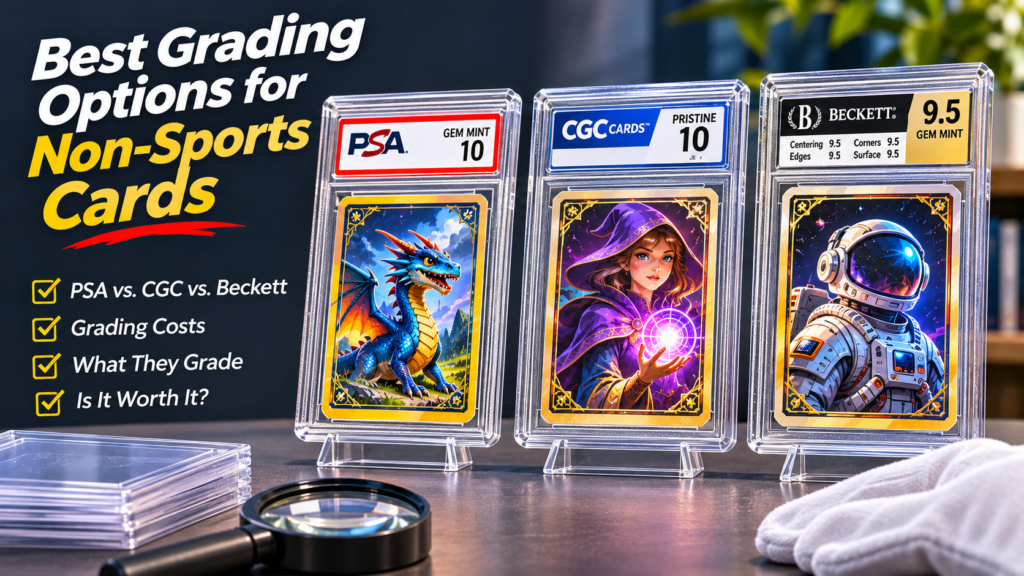
Best Grading Options for Non-Sports Cards (2026)
Best Grading Options for Non-Sports Cards: PSA vs. CGC vs. Beckett (2026 Guide)
Which Card Grading Company Is Best for Pokémon, Magic: The Gathering, Entertainment Cards, Vintage Collectibles, and Custom Trading Cards?
Published by NCASE CARDS | November 2026 | United States
Publisher disclosure: This guide is published by NCASE CARDS, a company specializing in premium personalized trading cards and collectible display products. NCASE is not a professional third-party card grading company and is not affiliated with PSA, CGC, Beckett, or other grading services discussed here.
What Is the Best Grading Company for Non-Sports Cards?
Quick Answer: PSA, CGC Cards, and Beckett Grading Services (BGS) are three leading options to consider for grading non-sports trading cards in the United States.
- PSA: A strong option for collectors who prioritize broad market recognition, established grading records, and resale comparisons.
- CGC Cards: Particularly appealing for Pokémon, Magic: The Gathering, Yu-Gi-Oh!, and other trading card games, as well as many entertainment collectibles.
- Beckett (BGS): A compelling option for collectors who value detailed condition assessments, including centering, corners, edges, and surface.
For personalized trading cards, original artwork, or privately produced collectibles, professional grading may not be necessary—or available. Grading companies have eligibility requirements and may reject certain unlicensed or custom-made cards.
In those cases, premium protective cases and display holders can provide an alternative for preserving and showcasing meaningful cards.
The best grading choice depends on the card’s category, value, condition, collector demand, and intended purpose.
This guide compares the major options, explains grading terminology, explores costs, and helps beginners decide whether grading is worth the investment.
Best Non-Sports Card Grading Companies Compared
| Grading Company | Best For | Main Strength | Potential Drawback |
|---|---|---|---|
| PSA | Collectors focused on market recognition and resale | Established collector marketplace | Fees and turnaround times vary |
| CGC Cards | TCGs and entertainment collectibles | Strong specialization in gaming and non-sports cards | Some card types are ineligible |
| Beckett (BGS) | Premium cards and detailed condition assessment | Four condition subgrades | Grading tiers and costs require comparison |
| Other specialty graders | Niche collecting preferences | Different pricing and presentation options | Recognition and eligibility vary |
| Protective display cases | Personal, custom, and commemorative cards | Preservation and presentation without grading | No independent condition certification |
Important: A professional grading company evaluates authenticity and condition. A protective case manufacturer does not automatically provide those services.
1. PSA: Best for Established Market Recognition
Professional Sports Authenticator (PSA) is one of the best-known names in trading card grading.
Despite the word Sports in its name, PSA grades many non-sports trading cards, including collectible card games and other eligible releases.
What Does PSA Do?
PSA evaluates submitted cards for authenticity and condition.
Eligible cards receive a numerical grade based on PSA’s grading standards.
Certified cards are then encapsulated in protective holders with identifying labels and certification numbers.
Why Collectors Choose PSA
Established recognition: PSA grades are widely referenced in the trading card marketplace.
Condition assessment: PSA uses a numerical grading scale to evaluate card condition.
Certification verification: Buyers can look up certification information through PSA’s online tools.
Population reports: PSA provides information about how many examples of particular cards have received specific grades.
Best Non-Sports Cards to Submit to PSA
PSA may be suitable for eligible:
- Pokémon cards.
- Magic: The Gathering cards.
- Yu-Gi-Oh! cards.
- Entertainment trading cards.
- Vintage non-sports collectibles.
- Higher-value character and promotional cards.
Always verify that PSA accepts the exact product before submitting.
What Are the Drawbacks?
Grading costs can be significant relative to the value of an inexpensive card.
Turnaround times depend on the service selected and current demand.
A card may also receive a lower grade than expected.
Best for: Collectors seeking a recognized grading service for established card releases.
2. CGC Cards: Best for Trading Card Games and Entertainment Collectibles
CGC Cards is another major professional grading option.
CGC grades a broad range of trading card games and non-sports collectibles.
Its published grading coverage includes popular TCGs and entertainment card categories.
What Types of Cards Does CGC Grade?
Examples include eligible cards from:
- Pokémon.
- Magic: The Gathering.
- Yu-Gi-Oh!.
- Flesh and Blood.
- Weiss Schwarz.
- Marvel collectibles.
- DC collectibles.
- Garbage Pail Kids.
CGC’s official eligibility rules determine which individual cards and releases qualify.
Why Choose CGC?
TCG specialization: CGC has extensive experience with collectible gaming cards.
Condition grading: Cards are evaluated using a published numerical grading system.
Encapsulation: Certified cards receive protective, tamper-evident holders.
Certification lookup: Collectors can verify grading records online.
Premium grades: CGC distinguishes Gem Mint 10 from its more selective Pristine 10 designation.
CGC Grading Costs
CGC publishes several grading tiers based on declared card value and service speed.
Its U.S. fee schedule includes economy, bulk, standard, express, and higher-value services.
Bulk services may require a minimum number of cards.
Always check current pricing and eligibility before submitting.
Important Limitations
CGC does not accept every card.
Its official exclusions include certain unlicensed fantasy or ACEO cards, along with specific other releases.
This is especially relevant for people considering grading original custom trading cards.
Best for: Pokémon collectors, TCG enthusiasts, and collectors of eligible entertainment cards.
3. Beckett Grading Services: Best for Detailed Condition Subgrades
Beckett Grading Services, commonly called BGS, is another established card grading provider.
Beckett evaluates sports, gaming, and non-sports trading cards.
Its distinctive feature is the use of detailed condition subgrades.
What Are Beckett Subgrades?
Beckett can evaluate four condition categories:
Centering: How accurately the card’s design is positioned.
Corners: The physical condition of the card’s corners.
Edges: The condition of the card’s perimeter.
Surface: Scratches, print defects, wear, and other surface characteristics.
These subgrades can help collectors better understand a card’s overall assessment.
Why Choose Beckett?
Detailed grading: Subgrades provide more information about condition.
Premium presentation: Beckett’s label system distinguishes high-end grades.
Non-sports eligibility: Beckett explicitly grades gaming and entertainment cards.
Collector familiarity: BGS has an established presence in the graded card market.
Beckett Black Label vs. Gold Label
Beckett uses distinctive labels for its highest-grade cards.
Its Black Label designation is associated with cards that achieve perfect subgrades.
Gold labels are used for certain other premium grades.
These designations should not be confused with a card’s printing finish.
A gold-colored custom trading card is not automatically a Beckett Gold Label collectible.
Potential Drawbacks
Grading costs and service availability vary.
Subgrades may affect pricing.
A high numerical grade does not guarantee that grading will increase the card’s resale value enough to recover the cost.
Best for: Collectors who value detailed condition information and premium grading presentation.
PSA vs. CGC vs. Beckett: Which Is Better?
There is no universally superior grading company.
The best choice depends on the specific card and your collecting priorities.
| Collector Priority | Company to Consider |
|---|---|
| Established resale comparisons | PSA |
| Pokémon and other TCG collections | CGC or PSA |
| Detailed condition subgrades | Beckett |
| Entertainment cards | CGC, PSA, or Beckett, subject to eligibility |
| Vintage non-sports collectibles | PSA or another established grader accepting the release |
| Premium high-grade presentation | Beckett or CGC |
| Personally designed custom cards | Confirm eligibility first; protective display may be more practical |
Before choosing a grading service, compare actual sold prices for the same card, grade, and grading company.
Do not assume identical grades from different companies command identical prices.
How Does Non-Sports Card Grading Work?
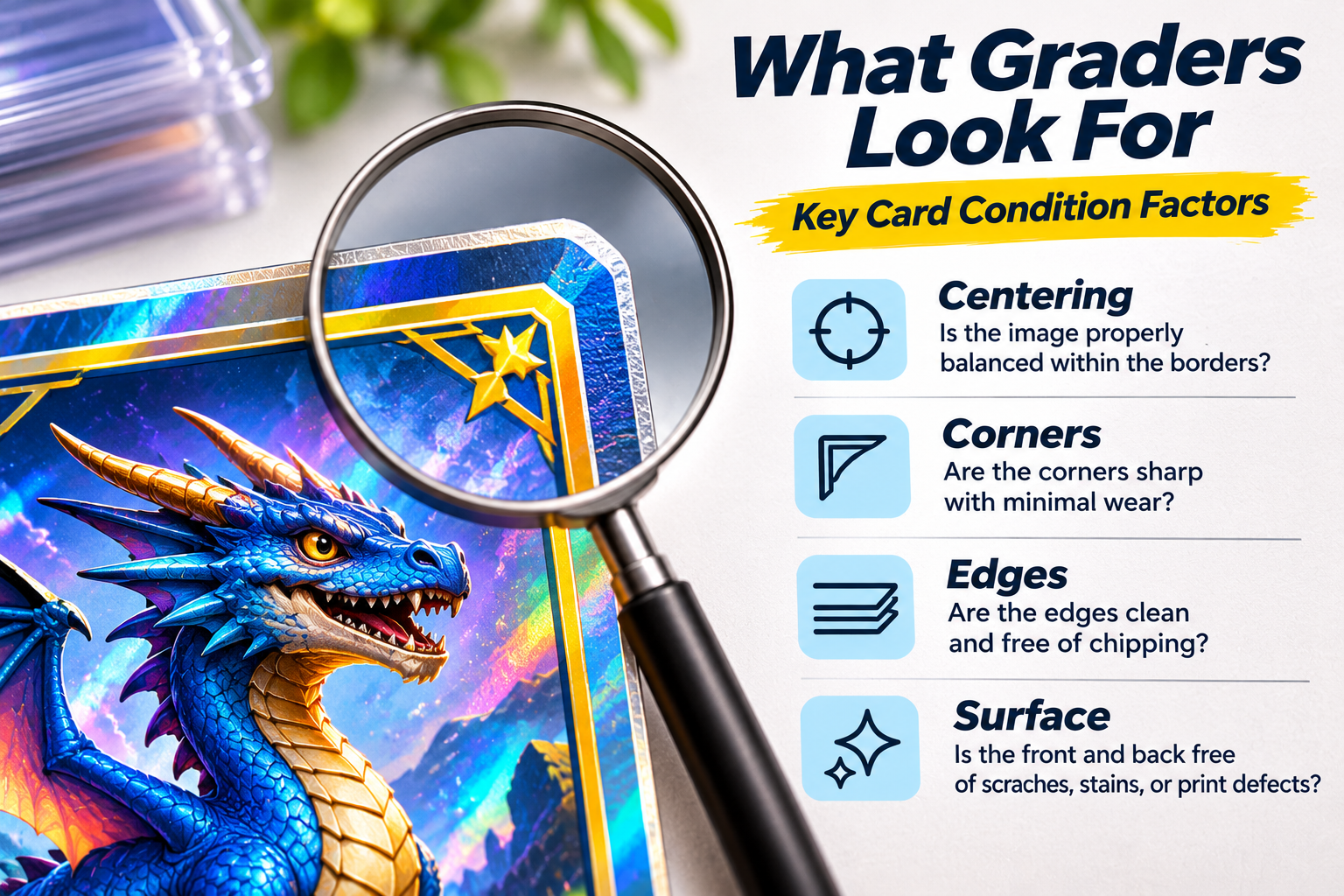
Professional grading generally involves several steps.
Step 1: Authentication
The grading company examines the card to determine whether it is genuine and eligible for certification.
This may include reviewing printing characteristics, dimensions, and other identifying features.
Step 2: Condition Evaluation
The card is assessed for defects and wear.
Common factors include centering, corners, edges, and surface condition.
Step 3: Grade Assignment
The grading company assigns a numerical condition grade according to its own standards.
A grade of 10 generally represents an exceptionally high-quality example, but grading scales and criteria differ between providers.
Step 4: Encapsulation
Eligible certified cards are placed inside protective holders, commonly called slabs.
Step 5: Certification
The holder typically includes a label identifying the card, its grade, and a certification number.
Collectors may use that number to access the grading company’s records.
Understanding the 1–10 Card Grading Scale
Many professional grading services use a numerical scale from 1 to 10.
| General Grade Range | Broad Description |
|---|---|
| 10 | Exceptional condition under the company’s standards |
| 9 | Very high condition with limited imperfections |
| 8 | Strong condition with some detectable flaws |
| 6–7 | Noticeable but moderate imperfections |
| 4–5 | More substantial wear or defects |
| 1–3 | Significant condition problems |
This is a simplified educational overview, not an official grading standard.
A PSA 10, CGC 10, and Beckett 10 are not necessarily equivalent.
Collectors should consult each company’s published criteria.
How Much Does It Cost to Grade Non-Sports Cards?
Grading fees depend on the company, service tier, declared value, and current availability.
As a general planning framework, lower-tier services can cost tens of dollars per card, while expedited or high-value submissions can cost considerably more.
Additional expenses may include:
- Shipping to the grading company.
- Return shipping.
- Insurance.
- Membership fees.
- Optional services.
- Applicable taxes.
- Higher service tiers required by card value.
Example: Is Grading a $20 Card Worth It?
Suppose you own a non-sports card worth approximately $20 ungraded.
If grading, shipping, and other costs total $35, your total economic outlay becomes approximately $55.
If the graded card sells for only $40, grading would not have been financially worthwhile.
However, if you are grading the card for your personal collection, financial return may not be the primary goal.
The key lesson: Compare the total grading expense with realistic market prices, not optimistic asking prices.
Which Non-Sports Cards Are Worth Grading?
Professional grading may make sense for cards with established collector demand or significant personal importance.
1. Valuable Pokémon Cards
Rare or desirable Pokémon cards may benefit from independent authentication and condition assessment.
2. Vintage Entertainment Cards
Older non-sports cards may warrant grading when authenticity and preservation are important.
3. Rare Trading Card Game Releases
Certain promotional cards, early releases, and scarce variants may have established graded markets.
4. Autograph Cards
Eligible autograph cards may benefit from grading or signature authentication, depending on the product and service.
5. High-Value Character Collectibles
Some licensed entertainment cards have active secondary markets where condition can influence pricing.
6. Personally Significant Cards
A collector may choose grading for a cherished card even when there is little financial incentive.
The decision should reflect the card’s significance and the cost involved.
Which Cards Should Beginners Avoid Grading?
Not every card needs professional grading.
Beginners should think carefully before submitting:
Low-value common cards: Grading may cost more than the card is worth.
Heavily damaged cards: A low grade may not justify the expense unless the card is historically important.
Unverified custom cards: The grading company may not accept the product.
Cards with no established resale demand: Certification does not automatically create a market.
Cards intended only as gifts: A protective display case may provide the presentation you want without professional grading.
Can Custom Trading Cards Be Professionally Graded?
Sometimes, but acceptance is not guaranteed.
This is an important consideration for people creating personalized trading cards, original characters, artist cards, or independently produced collectibles.
Grading companies establish their own eligibility rules.
They may decline cards that are unlicensed, undocumented, privately produced, or outside supported product categories.
For example, CGC expressly excludes certain unlicensed ACEO fantasy cards.
Other grading services have their own requirements.
What Should You Do Before Submitting a Custom Card?
Contact the grading company and provide:
- The card manufacturer.
- The product name or release.
- The year of production.
- The card’s dimensions.
- Front and back photographs.
- Information about the edition or print run.
- Any available documentation.
Ask for confirmation that the exact card is eligible.
Do not assume a card is accepted simply because it has standard trading card dimensions.
Professional Grading vs. Protective Display Cases
Professional grading and protective encapsulation serve related but different purposes.
| Feature | Professional Grading Slab | Premium Protective Display Case |
|---|---|---|
| Physical protection | Yes | Yes |
| Display presentation | Yes | Yes |
| Numerical condition grade | Yes, if graded | No |
| Independent authentication | Usually part of certification | No |
| Certification number | Typically | Not inherently |
| Third-party grading standards | Yes | No |
| Appropriate for personal custom cards | Only if eligible | Often |
| Requires professional submission | Yes | No |
A display case can help protect a collectible and make it easier to showcase.
But a protective case alone does not authenticate a card or establish a professional grade.
NCASE CARDS: A Premium Display Alternative for Personalized Collectibles
NCASE CARDS creates premium personalized trading cards designed to celebrate athletes, families, original characters, and meaningful moments.
Unlike professional grading companies, NCASE focuses on the creation and presentation of personalized collectibles.
Its products can feature custom photographs, player details, premium card stock, and selected holographic finishes.
Certain NCASE products include protective acrylic display options.
Why Does This Matter for Custom Cards?
Imagine creating a trading card featuring your child’s first baseball season.
The card may have tremendous emotional value to your family.
But that does not mean it needs a professional numerical grade.
A premium protective case may be sufficient to display and preserve the keepsake.
The same principle applies to:
- Personalized pet trading cards.
- Original fantasy characters.
- Custom team collectibles.
- Graduation cards.
- Commemorative family cards.
- Personalized gifts.
For these products, presentation and emotional significance may matter more than third-party certification.
Is an NCASE Acrylic Case the Same as a PSA Slab?
No.
A NCASE protective acrylic case is a display and protection product.
A PSA slab is part of a professional authentication and grading service.
These products serve different purposes and should not be represented as equivalent certifications.
How to Protect Non-Sports Cards Without Grading Them
If professional grading is not appropriate, several protective storage options are available.
Penny Sleeves
Soft card sleeves provide a basic barrier against handling and surface wear.
Toploaders
Rigid holders offer additional physical support when used with appropriate sleeves.
Magnetic Card Holders
Magnetic holders can provide convenient display access, provided the holder fits the card correctly.
Acrylic Display Cases
Acrylic cases can provide a substantial presentation for special collectibles.
Card Binders
Binders are useful for organizing larger collections, particularly when paired with suitable protective sleeves.
Storage Boxes
Archival-quality storage materials can help keep collections organized and protected.
Avoid excessive heat, humidity, sunlight, and unnecessary handling.
For valuable collectibles, choose materials intended for long-term card storage.
Does Grading Increase the Value of Non-Sports Cards?
It can, but there is no guarantee.
A desirable card with a strong grade may sell for more than an equivalent ungraded example.
However, the financial benefit depends on several factors.
Card Demand
Collectors must actually want the card.
Condition
A lower-than-expected grade may limit resale potential.
Population
The number of certified examples at a particular grade can affect perceived scarcity.
Grading Company
Collectors may pay different amounts for cards graded by different services.
Market Conditions
Collectible prices fluctuate.
Total Grading Cost
Any potential resale premium must be evaluated against grading and transaction expenses.
Grading documents condition; it does not manufacture demand.
How to Estimate Whether Grading Is Financially Worthwhile
Use this simple calculation:
Estimated net benefit = Expected graded sale proceeds − grading costs − shipping − selling fees − estimated ungraded sale proceeds
Hypothetical Example
Suppose:
- Estimated ungraded sale proceeds: $40.
- Expected graded sale proceeds: $100.
- Grading fee: $25.
- Shipping and insurance: $12.
- Selling fees: $13.
The estimated net benefit would be:
$100 − $25 − $12 − $13 − $40 = $10
That is a relatively small margin given the uncertainty of the final grade and selling price.
This calculation is illustrative, not a forecast.
If the card receives a lower grade than expected, the economics may change substantially.
How to Prepare Non-Sports Cards for Grading
Step 1: Inspect the Card
Examine the corners, edges, surface, and centering.
Use good lighting and avoid unnecessary handling.
Step 2: Research Comparable Sales
Look at completed sales for the same card and grade.
Step 3: Confirm Eligibility
Review the grading company’s accepted-card policies.
Step 4: Choose the Correct Service
Consider declared value, grading fees, and estimated turnaround time.
Step 5: Follow Packaging Instructions
Use the grading company’s current submission guidelines.
Step 6: Document the Submission
Keep photographs, receipts, tracking information, and submission records.
Step 7: Review the Returned Certification
Check the card description, grade, and certification information.
Common Card Grading Mistakes to Avoid
Assuming every card deserves a grade: Many cards are better kept ungraded.
Ignoring shipping expenses: Total costs can exceed the advertised grading fee.
Expecting a perfect 10: Even cards that appear flawless can have manufacturing defects.
Confusing authentication with valuation: A genuine card is not necessarily valuable.
Assuming custom cards are eligible: Verify acceptance before shipping.
Confusing acrylic holders with certified slabs: Protection does not equal grading.
Using asking prices instead of sold prices: Listing prices do not establish actual market value.
Treating grading as an investment guarantee: Card values can decline regardless of certification.
Frequently Asked Questions About Non-Sports Card Grading
What is the best company for grading non-sports cards?
PSA, CGC Cards, and Beckett are three established options. The best choice depends on the card type, collector demand, grading preferences, and current service costs.
Does PSA grade non-sports cards?
Yes. PSA grades many eligible non-sports and trading card game products.
Does CGC grade non-sports trading cards?
Yes. CGC grades a broad range of trading card games and entertainment collectibles, subject to eligibility rules.
Does Beckett grade Pokémon cards?
Yes. Beckett grades eligible gaming cards, including Pokémon.
Which grading company is best for Pokémon?
PSA, CGC, and Beckett are all worth considering. Compare fees, grading standards, and market prices for the specific card.
Is PSA better than CGC?
Neither is universally better. PSA may appeal to collectors prioritizing established resale comparisons, while CGC is a strong option for trading card games and non-sports collectibles.
Is Beckett grading better than PSA?
Beckett offers detailed subgrades, while PSA uses its own grading system and has broad market recognition. The better choice depends on your goals.
What does PSA 10 mean?
PSA 10 is PSA’s Gem Mint grade, assigned according to its published grading standards.
What does CGC Pristine 10 mean?
CGC Pristine 10 is a premium designation reserved for cards meeting CGC’s highest condition criteria.
What is a Beckett Black Label?
Beckett’s Black Label identifies a perfect 10 card under its grading system, including perfect subgrades.
How much does non-sports card grading cost?
Costs vary by company, service tier, declared value, and additional services. Review current official fee schedules before submitting.
Is grading worth it for inexpensive cards?
Often not for resale purposes, because grading and shipping costs can exceed any potential increase in value.
Can I grade movie trading cards?
Many movie and entertainment trading cards are eligible for grading, depending on the manufacturer, release, and grading company’s policies.
Can I grade Star Wars trading cards?
Many officially produced Star Wars trading cards are eligible for grading. Verify the specific release.
Can I grade custom trading cards?
Some custom or independently produced cards may be ineligible. Contact the grading company before submitting.
Can I grade a personalized NCASE trading card?
Eligibility would need to be confirmed directly with the grading company. NCASE does not guarantee that personalized cards will be accepted for third-party grading.
Are acrylic display cases the same as grading slabs?
No. Acrylic display cases protect and showcase cards but do not inherently provide independent authentication or a numerical condition grade.
Does grading guarantee a card will increase in value?
No. Grading may improve buyer confidence, but resale value depends on demand, condition, rarity, and market conditions.
Should I grade cards before selling them?
Compare expected graded sale prices with ungraded values and the full cost of grading. Grading is not always financially beneficial.
Can I protect my trading cards without grading them?
Yes. Sleeves, toploaders, magnetic holders, binders, and protective acrylic cases can all help preserve cards.
Where can I find official grading prices?
Visit the official PSA, CGC Cards, and Beckett grading websites for current pricing and submission requirements.
Final Verdict: Which Grading Option Should You Choose?
For established non-sports collectibles with active secondary markets, professional grading can provide useful authentication and condition information.
Choose PSA when broad market recognition and comparable graded sales are important.
Choose CGC Cards when collecting eligible TCGs or entertainment cards and you value its specialized certification services.
Choose Beckett when detailed condition subgrades and premium grading presentation are priorities.
Choose premium protective display when the card is primarily a personal keepsake, a gift, or an original collectible that does not require independent grading.
For NCASE customers, the important distinction is that a personalized trading card can be meaningful without ever receiving a professional grade.
A card celebrating your child, your pet, your original character, or your favorite memory does not need a secondary-market price to deserve protection.
Sometimes, its greatest value is the story it preserves.
Protect the Moments That Matter With NCASE CARDS
At NCASE CARDS, we believe collectible-quality presentation should not be reserved exclusively for professional athletes or expensive hobby cards.
Your first season. Your championship. Your favorite character. Your proudest achievement.
These moments deserve to be remembered.
Our premium personalized trading cards and protective display options make it possible to turn meaningful photographs and stories into keepsakes designed to be seen and kept.
Your Game. Your Story. Your Card.
Explore Premium Personalized Trading Cards
NCASE the Moment.
Editorial note: Grading fees, accepted card categories, turnaround times, and service availability may change. Always confirm current information directly with the grading provider. NCASE CARDS does not provide independent card grading, authentication, or guaranteed resale valuations.