
How to Make Custom Trading Cards for Your School
How to Make Custom Trading Cards for Your School: The Complete Guide
Imagine walking into a school where every student has their own trading card.
A fifth grader proudly showing off a personalized card featuring their school portrait. A high school basketball player sharing a custom sports card with teammates. A classroom of students exchanging cards celebrating their favorite subjects, activities, and accomplishments.
Even teachers, principals, school mascots, and staff members could become part of the collection.
Custom school trading cards turn the excitement of traditional sports card collecting into a personalized experience that celebrates students, teachers, classrooms, athletic teams, and entire school communities.
But how do you create custom trading cards for an entire school?
Do teachers need to collect every student’s photo? Can parents create their own child’s card? How do you coordinate different classrooms and grade levels? And can schools use personalized trading cards for fundraising?
The good news is that with the right approach, a custom school trading card program can be simple to organize, even for schools with hundreds of students.
This complete guide explains how to make custom trading cards for your school, what information to include, how to coordinate ordering, and how personalized collectibles can support student recognition, school spirit, fundraising, and lasting memories.
How Do You Make Custom Trading Cards for Your School?
To make custom trading cards for a school, choose a card provider, establish a school design, organize participating classrooms or groups, collect student photographs and approved information, and coordinate ordering and delivery. A self-service group ordering platform can simplify the process by allowing parents to personalize and purchase their own child’s card.
Schools can use custom trading cards for individual students, classrooms, athletic programs, graduation celebrations, fundraising campaigns, and school-wide recognition programs.
With NCASE CARDS, the goal is to make personalized trading cards accessible without requiring teachers and administrators to design every individual card.
How to Make Custom School Trading Cards in 4 Easy Steps
A school-wide trading card program can follow four straightforward stages.
Step 1: Set Up Your School and Participating Groups
Begin by establishing your school trading card program.
Decide whether you want to include an individual classroom, an entire grade level, a school sports team, or the entire student body.
For larger programs, organize participants into manageable groups such as classrooms, grades, clubs, or athletic teams.
A school-wide setup should provide a consistent starting point for the different groups.
Step 2: Share Ordering Links With Teachers and Families
Once the participating groups are organized, provide the appropriate ordering links to teachers or designated group leaders.
Those links can then be shared with participating families using approved school communication channels.
This approach can help reduce the need for administrators to manually collect photographs, player information, and individual payments.
Step 3: Parents Personalize Their Child’s Trading Card
Participating families can provide the photograph and personal details needed for their child’s card.
Depending on the available customization options, a school card may include a student’s name, grade, classroom, interests, school colors, and approved design elements.
Families should review the completed card for accuracy before submitting their orders.
The objective is to allow each household to manage its own student’s information while maintaining a coordinated school design.
Step 4: Produce and Distribute the Cards
Once orders are submitted, the cards move into production.
Depending on the provider and the program’s fulfillment arrangements, orders may be shipped to a school contact, teacher, administrator, or another approved destination.
For larger school programs, confirm packaging and distribution arrangements before launching.
One school. Every classroom. Every student with a card worth keeping.
What Are Custom School Trading Cards?
Custom school trading cards are personalized collectible cards featuring students, teachers, school teams, clubs, or other members of a school community.
They use design elements associated with traditional trading cards, such as photographs, names, colorful backgrounds, school information, and premium finishes.
Unlike traditional sports cards featuring professional athletes, custom school trading cards celebrate individuals within the school community.
For example, a school might create personalized cards for an entire fifth-grade class.
A middle school could produce cards for its student council, robotics club, and sports teams.
A high school could offer collectible senior cards, varsity athlete cards, and special graduation editions.
The concept is flexible enough to work across academic, athletic, creative, and extracurricular programs.
What Information Can You Put on a Student Trading Card?
The best custom student trading cards balance personalization with a clean, attractive design.
Possible information includes:
- Student’s first name or approved display name
- Student photograph
- School name
- Grade or classroom
- School colors
- Approved school logo or mascot
- Favorite subject
- Favorite activity or hobby
- Club or athletic team
- Personal achievement
- Graduation year
- A short student-approved quote or message
- Special artwork or commemorative design
Not every field is appropriate for every age group or project.
Schools should avoid unnecessary personal information, especially for younger students.
For example, there is generally no reason to include a student’s home address, personal phone number, date of birth, or private contact details on a collectible card.
What Makes a Good School Trading Card Design?
A strong design should be recognizable, attractive, and easy to read.
The student’s photograph should be the visual focus.
Names should be clearly displayed.
School colors and approved visual elements can connect individual cards to the larger school collection.
For school-wide programs, maintaining a consistent layout helps the cards feel like part of a coordinated series.
Can You Make Trading Cards for Every Student in a School?
Yes. Custom trading cards can be organized for individual classrooms, entire grade levels, or a full student body.
The key challenge is not designing a single card.
It is creating an efficient process for organizing many participants.
Example: A School With 500 Students
Consider a hypothetical school with 500 students across 20 classrooms.
| Program Detail | Example |
|---|---|
| Total students | 500 |
| Classrooms | 20 |
| Average students per classroom | 25 |
| Potential individual designs | 500 |
| Potential family orders | Up to 500 |
A traditional manual approach might require school staff to gather hundreds of photographs, verify information, collect payments, and coordinate individual card designs.
A self-service ordering approach allows participating families to handle much of their own customization.
Teachers or other group leaders primarily help distribute ordering information and communicate deadlines.
The actual number of orders depends on family participation and whether the school makes the program optional or school-sponsored.
How Do You Organize Custom Trading Cards for Multiple Classrooms?
School programs can benefit from a structure that separates responsibilities between the school, teachers, and families.
School Administrators
Administrators establish the program, coordinate permissions, approve the design approach, and determine participating groups.
Teachers and Classroom Leaders
Teachers or designated classroom contacts distribute the appropriate ordering links and communicate deadlines.
They do not necessarily need to collect individual photographs or design each student’s card.
Parents and Guardians
Families provide photographs and approved student information, personalize their cards, and complete individual purchases when applicable.
How Could a School-Wide Ordering Structure Work?
A practical organization might look like this:
School → Grade Level or Classroom → Parent or Guardian
The school oversees the overall program.
Each participating teacher or classroom leader receives the appropriate group ordering link.
Families then use that group’s link to personalize and purchase individual student cards.
This structure can help preserve a consistent school experience while organizing orders by classroom.
The exact group hierarchy and features should be confirmed with the chosen card provider.
What Are the Best Custom Trading Card Ideas for Schools?
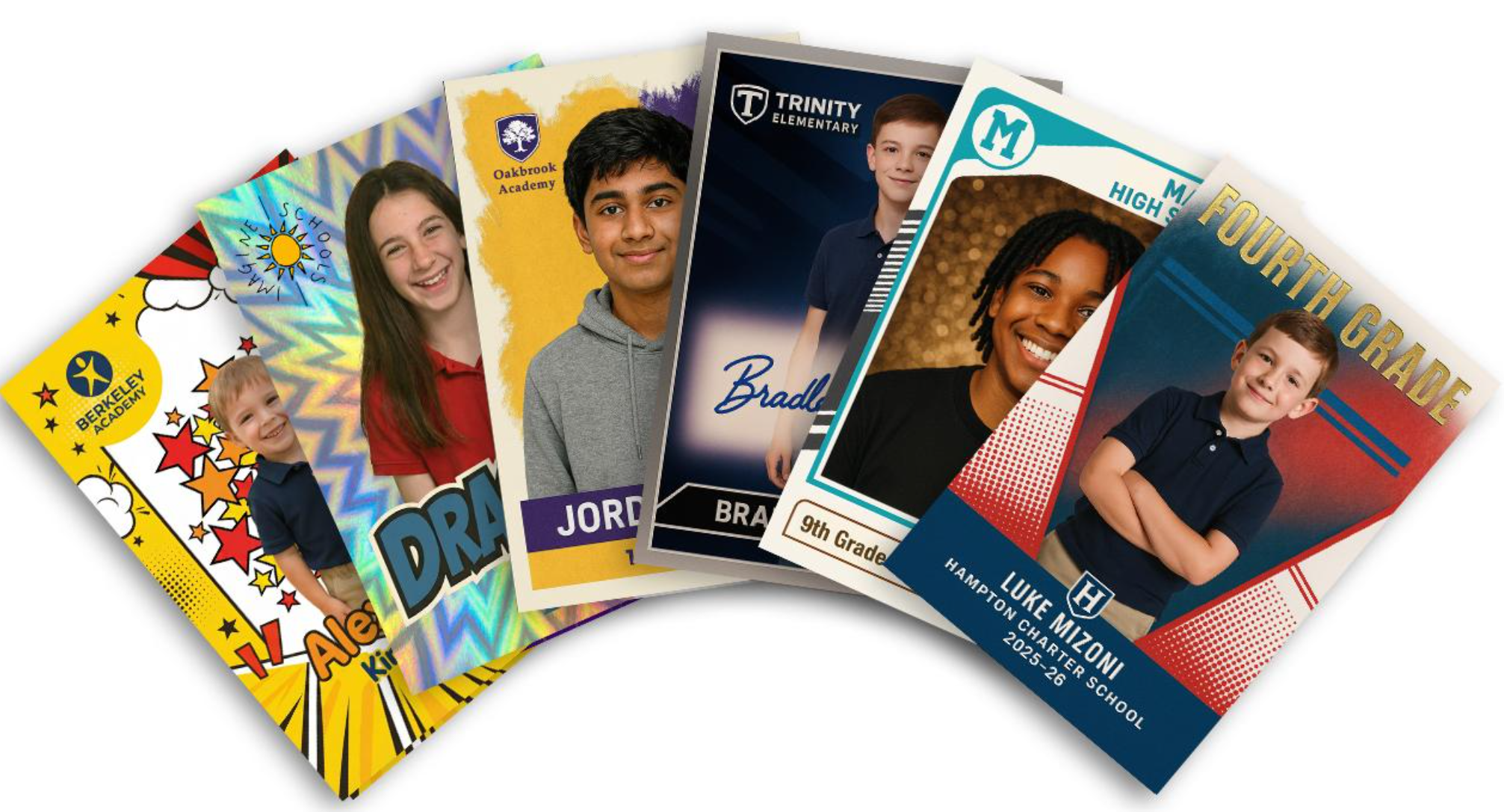
Custom Trading Cards for Schools
Custom trading cards can support many school activities beyond athletics. Custom Cards are perfect for every occasion worth remembering.
1. Student Recognition Trading Cards
Schools can create personalized cards recognizing academic achievement, leadership, good citizenship, creativity, and other accomplishments.
A student might receive a special card celebrating their participation in a reading challenge, science competition, or community service project.
2. Classroom Trading Card Collections
Teachers can develop classroom collections featuring participating students.
These cards can become memorable keepsakes at the end of the school year.
For younger children, classroom cards can celebrate interests, creativity, and participation without turning recognition into an overly competitive activity.
3. School Sports Trading Cards
Student athletes can receive cards featuring their photographs, uniforms, jersey numbers, school colors, and team information.
This works for football, baseball, basketball, soccer, hockey, volleyball, softball, wrestling, track and field, and other school sports.
4. Graduation and Senior Trading Cards
Graduating students can create personalized cards commemorating their final school year.
Cards might feature senior photographs, graduation year, approved personal messages, and memorable achievements.
5. School Clubs and Extracurricular Activities
Custom cards can celebrate robotics teams, debate clubs, theater groups, marching bands, student government, academic teams, and other organizations.
6. Teacher and Staff Trading Cards
Schools can create collectible cards highlighting teachers, principals, counselors, librarians, and other staff members.
These may be especially engaging for teacher appreciation events or school anniversaries.
7. School Mascot Trading Cards
A school mascot card can become a fun addition to a school-wide collection.
Some schools may also create special editions celebrating school spirit events or important milestones.
8. End-of-Year Keepsake Cards
Instead of relying exclusively on traditional school souvenirs, families can preserve a school year through a personalized student trading card.
The card might commemorate a grade level, classroom, team, or memorable achievement.
Are Custom Trading Cards Good for Elementary Schools?
Yes. Personalized trading cards can be especially engaging for elementary school students because the concept is visual, familiar, and easy to understand.
A child can see their own photograph and name on a collectible that resembles the cards they may already recognize from sports or games.
Elementary School Trading Card Ideas
Schools might create cards for:
- Classroom participation
- Reading milestones
- School spirit celebrations
- Field day events
- Fifth-grade promotion
- Student artwork showcases
- After-school programs
- School year keepsakes
For younger students, the emphasis should be on inclusion, creativity, and celebrating individual accomplishments.
Parental involvement in photo selection and information submission is especially important.
Can Middle Schools and High Schools Create Their Own Trading Cards?
Yes. Middle schools and high schools can create personalized cards for students, athletic programs, graduating classes, clubs, and special events.
Older students may be especially interested in selecting their own photographs and personalizing their designs.
Middle School Trading Cards
Middle schools can use cards to celebrate athletics, student leadership, school clubs, academic competitions, and promotion ceremonies.
High School Trading Cards
High schools can offer personalized varsity sports cards, senior cards, performing arts cards, and special recognition collectibles.
A high school football team might create coordinated cards for its full roster.
A theater department could celebrate its graduating performers.
A student government organization could create collectible cards featuring its members.
Can Schools Make Custom Rookie Cards?
Yes. Schools can create rookie-style custom trading cards celebrating a student’s first year on a team, first season in an activity, or first major school achievement.
A personalized NCASE rookie-style design is a commemorative concept and should not be confused with an officially issued professional sports rookie card produced by Topps, Panini, Leaf or Upper Deck.
Can Schools Make Professional-Quality Holographic Trading Cards?
Yes. Custom school trading cards can be professionally manufactured with premium printing, standard trading card dimensions, holographic finishes, and protective display options.
The exact features depend on the card manufacturer.
Many modern sports cards use the familiar dimensions of 2.5 inches by 3.5 inches, and custom cards can follow the same format.
What Are Holographic School Trading Cards?
Holographic school trading cards feature reflective effects that change in appearance as the card moves under light.
A holographic finish can make an ordinary school portrait or athletic photograph feel more like a premium collectible.
What Are Rainbow and Cracked Ice Finishes?
Rainbow holographic finishes produce multicolored reflective effects.
Cracked ice-style finishes feature a patterned reflective surface resembling fractured ice.
These treatments are commonly associated with modern collectible card aesthetics.
NCASE CARDS offers available holographic finish options, including rainbow and cracked ice-style designs.
What Is the NCASE Core Edition?
The NCASE Core Edition combines a personalized holographic trading card with a customized acrylic slab and protective bumper frame.
The acrylic slab offers a premium way to display the card.
It is a protective presentation product, not a third-party professional grading service.
What Is the Difference Between Raw School Trading Cards and Premium Slabbed Cards?
Schools may want different product options depending on the budget, occasion, and intended use.
| Feature | Raw Trading Card | NCASE Core Edition |
|---|---|---|
| Personalized student photograph | Yes | Yes |
| Student name and information | Yes | Yes |
| Standard collectible format | Yes | Yes |
| Holographic options | Available on selected cards | Included |
| Customized acrylic slab | No | Yes |
| Protective bumper frame | No | Yes |
| Suitable for classroom collections | Yes | Yes |
| Premium gift presentation | Optional | Included |
| General cost | Typically lower | Typically higher |
Raw cards can be practical for school-wide participation, trading, and larger collections.
Premium slabbed cards can be especially appealing for graduation gifts, athletic recognition, special achievements, and personal displays.
How Much Does It Cost to Make Custom Trading Cards for a School?
The cost of custom school trading cards depends on the number of cards ordered, printing finish, design requirements, product selection, packaging, and shipping. Group pricing may reduce the cost per card for qualifying school orders.
A school should first determine how the program will be funded.
Option 1: Parent-Purchased Cards
Each family chooses whether to order and pays for its own student’s card.
This can reduce the school’s upfront financial commitment.
Option 2: School-Sponsored Cards
The school or an affiliated organization purchases cards for participating students.
This approach may be appropriate for recognition programs, graduation gifts, or school-funded events.
Option 3: PTO or PTA Fundraising Program
A parent organization coordinates a trading card campaign with an agreed fundraising structure.
Families purchase personalized cards, and qualifying proceeds support the school’s approved fundraising goals.
Example School Trading Card Budget
Consider a hypothetical 300-student school with an optional card program.
If 60% of students participate, that would represent 180 student orders.
At a hypothetical average product price of $20 per card, gross product sales would total $3,600.
This is an illustrative planning example, not an NCASE quote or projected fundraising result.
Actual pricing, participation, taxes, shipping, and any fundraising contribution would need to be established before launch.
Can Custom Trading Cards Be Used for School Fundraising?
Yes. Personalized school trading cards can be incorporated into fundraising programs for schools, PTOs, PTAs, athletic boosters, and other approved school organizations.
Unlike generic fundraising products, custom cards feature the participating students themselves.
Parents receive a personalized keepsake while supporting a school initiative.
How Does a School Trading Card Fundraiser Work?
A school or parent organization can structure the program around five steps.
- Establish the fundraising goal and obtain necessary approvals.
- Choose the card products and agree on pricing.
- Invite participating families to create their cards.
- Coordinate ordering, production, and distribution.
- Direct the agreed fundraising proceeds to the organization.
Fundraising percentages, revenue-sharing arrangements, and program costs should be documented before the campaign begins.
What Can School Trading Card Fundraising Support?
Depending on school policies and organizational priorities, proceeds could support:
- Classroom supplies
- Athletic equipment
- Field trips
- Library programs
- Arts and music education
- Graduation celebrations
- School clubs
- Student scholarships
- Technology programs
- School improvement projects
Why Might Personalized Cards Work Well for School Fundraising?
The product creates a personal connection.
Instead of purchasing a generic item, a family receives a collectible featuring their student.
That connection can make the fundraising experience more meaningful.
However, a successful fundraiser still requires appropriate pricing, clear communications, realistic participation assumptions, and transparent accounting.
How Can Schools Use Trading Cards for Student Recognition?
Custom trading cards can provide a creative alternative to traditional certificates, ribbons, or recognition gifts.
For example, a school might create cards celebrating achievements in academics, athletics, service, or the arts.
Academic Recognition Cards
Students could be recognized for participation in reading programs, mathematics challenges, science fairs, or other academic activities.
Leadership Recognition Cards
Schools can celebrate student council participation, peer mentoring, volunteer projects, and leadership contributions.
Arts and Performing Arts Cards
Cards can recognize students participating in theater productions, bands, choirs, visual arts programs, and dance performances.
Athletic Recognition Cards
Student athletes can have personalized cards featuring their sport, uniform, team details, and favorite action photographs.
Inclusive School-Wide Recognition
Schools should consider creating opportunities for all students to participate.
A trading card collection can celebrate individual interests and experiences rather than recognizing only top performers.
This approach makes personalized school cards suitable for a wider range of students.
When Should Schools Order Custom Trading Cards?

Creating your NCASE CARD is easy and fast.
The best time depends on the purpose of the program.
Beginning of the School Year
Schools can introduce trading cards during welcome events, school spirit activities, or classroom introductions.
School Picture Day
Professional school portraits may be useful for personalized trading cards when the school or family has the appropriate rights to reproduce them.
Sports Seasons
Athletic programs can offer cards at the beginning or end of a season.
Teacher Appreciation Week
Schools can create recognition cards for teachers and staff.
Fundraising Campaigns
PTOs, PTAs, and booster organizations can coordinate approved sales campaigns.
Graduation and Promotion
Senior-year and promotion cards can become lasting keepsakes.
End-of-Year Celebrations
Schools can offer commemorative trading cards as part of classroom celebrations, field days, and school year milestones.
How Long Does Custom Trading Card Production Take?
Production depends on the manufacturer, product type, order volume, and customization requirements.
NCASE CARDS generally estimates 10 to 15 business days for standard custom card production, with shipping transit time additional.
Larger school-wide projects may require additional coordination.
Schools should allow sufficient time for family participation, order deadlines, production, shipping, and distribution.
Are Custom School Trading Cards Safe for Student Privacy?
Student privacy is an important part of planning any school trading card program.
Schools should establish appropriate permissions and carefully consider which student details are included.
Do Schools Need Permission to Use Student Photos?
Requirements depend on the school, the origin of the photographs, applicable laws, and how the images will be used or disclosed.
For U.S. schools subject to FERPA, some student photographs may qualify as education records or directory information depending on the circumstances.
Schools should review their policies and applicable legal requirements before sharing student information with a vendor.
What Student Information Should Be Avoided?
For school trading cards, avoid unnecessary personal information such as:
- Home addresses
- Personal phone numbers
- Exact dates of birth
- Private student identification numbers
- Sensitive educational records
- Personal contact information
- Other details not needed for the card
For younger students, consider using first names or another school-approved naming format.
Should Cards Be Available Publicly?
A private keepsake program differs from a public promotional campaign.
Schools should determine whether cards will be distributed only to participating families or displayed publicly.
If the cards will appear in marketing materials, public websites, or social media, review any additional permission requirements.
Who Should Submit Student Photographs?
For younger students, parent or guardian submission can help ensure that the images and personal details are reviewed by an appropriate adult.
Teachers and administrators should avoid transferring unnecessary student information to outside vendors.
How Do You Choose the Best Custom Trading Card Company for Schools?
Not every trading card company is equipped to coordinate an entire school.
Before selecting a provider, consider the following questions.
Does the Company Support Group Ordering?
A dedicated school or group ordering system can help organize classrooms, grade levels, and participating families.
Can Families Personalize Their Own Cards?
Individual customization can reduce the administrative burden on school staff.
Can Schools Use Consistent Designs?
A coordinated school design makes the collection visually cohesive.
Are the Cards Professionally Manufactured?
Review actual product photographs, printing specifications, finishes, and sample cards.
Are Multiple Price Points Available?
Raw card and premium presentation options can accommodate different budgets.
Is Bulk Pricing Available?
Ask about discounts for qualifying school or organization orders.
Can the Provider Support School Fundraising?
If fundraising is a goal, confirm the available commercial terms and administrative requirements.
How Is Student Information Protected?
Review the provider’s privacy practices, consent requirements, and image-handling procedures.
Can the Provider Meet the School’s Deadline?
Confirm production estimates and shipping arrangements before scheduling distribution.
Why Choose NCASE CARDS for Custom School Trading Cards?
At NCASE CARDS, we specialize in professional-quality personalized trading cards for athletes, families, teams, schools, leagues, and organizations.
We believe every student deserves an opportunity to celebrate their unique story.
Personalized Cards for Students
Students can be featured on custom trading cards using their own photographs and supported personal details.
Cards for School Sports Teams
Schools can create coordinated custom cards for baseball, football, basketball, soccer, hockey, and other athletic programs.
Premium Holographic Options
Available holographic finishes give personalized cards a collectible appearance inspired by modern sports card designs.
NCASE Core Edition
The NCASE Core Edition features a custom holographic card, a personalized acrylic slab label, and a protective bumper frame.
Group Ordering Convenience
NCASE CARDS supports group ordering concepts designed to help schools, teams, and other organizations coordinate personalized card programs.
Participating families can personalize individual cards through available online ordering workflows.
For a full school-wide deployment, administrators should confirm the current classroom setup, ordering links, approval processes, and shipment options with NCASE CARDS.
Opportunities for School Fundraising
Schools and parent organizations can discuss customized card programs that align with approved fundraising goals.
Celebrating More Than Athletics
Custom trading cards can recognize students, teachers, staff, clubs, classrooms, and special achievements.
From the first day of school to graduation, a personalized trading card can help preserve a moment worth remembering.
Explore NCASE CARDS and discover custom trading cards for your school.
Frequently Asked Questions About Custom School Trading Cards
How do you make custom trading cards for your school?
Choose a custom card provider, establish a coordinated school design, organize participating classrooms or groups, and collect approved student photographs and information. A self-service ordering system can allow parents to personalize individual cards and complete their own purchases.
Can you make custom trading cards for every student in a school?
Yes. School-wide trading card programs can include entire grade levels or student bodies. Successful programs require appropriate permissions, group organization, ordering procedures, and fulfillment planning.
What are custom school trading cards?
Custom school trading cards are personalized collectible cards featuring students, teachers, school teams, clubs, or staff members. They may include photographs, names, school colors, and approved information.
Can elementary school students have their own trading cards?
Yes. Elementary school trading cards can celebrate classroom participation, school spirit, interests, and end-of-year milestones. Parent or guardian involvement is especially important when submitting photographs and student information.
Can middle schools make custom student trading cards?
Yes. Middle schools can create trading cards for individual students, athletic programs, academic clubs, student leadership, and promotion celebrations.
Can high schools make personalized trading cards?
Yes. High schools can create custom sports cards, senior cards, graduation keepsakes, student recognition cards, and club collections.
Can teachers create trading cards for their classrooms?
Yes. Teachers can coordinate classroom trading card projects with appropriate school approval and parent permissions. A consistent classroom design can feature different student photographs and approved information.
Can parents design their child’s trading card?
Yes. Some custom card platforms allow parents to upload photographs, enter personal information, and customize individual cards.
Do teachers need to collect every student’s photograph?
Not necessarily. A self-service ordering system can allow participating families to submit photographs directly, reducing the work required from teachers.
Can you use school portraits on custom trading cards?
Potentially. Schools and families should confirm photo reproduction rights and any restrictions imposed by the photographer or photography provider.
Can school trading cards include the school logo?
Yes, when the school authorizes use of its logo and the manufacturer supports that design option.
Can school trading cards include a student’s name and grade?
Yes. However, schools should determine which student details are appropriate to disclose and obtain necessary permissions.
Can you create custom cards for school sports teams?
Yes. Personalized school sports cards can be created for football, basketball, baseball, softball, soccer, hockey, volleyball, wrestling, and other athletic programs.
Can school trading cards have holographic finishes?
Yes. Some custom trading card providers, including NCASE CARDS, offer premium holographic printing options.
Are custom school trading cards the same size as sports cards?
Many custom cards use the standard sports trading card dimensions of 2.5 by 3.5 inches, although other sizes are available from some providers.
Can school trading cards come in protective acrylic slabs?
Yes. The NCASE Core Edition includes a personalized holographic card, customized acrylic slab, and protective bumper frame.
How much do custom school trading cards cost?
Prices depend on quantity, product selection, printing finish, design requirements, packaging, and shipping. Qualifying group orders may receive discounted pricing.
Can schools order trading cards in bulk?
Yes. Custom card providers may offer bulk production or coordinated group ordering options for schools. Minimum quantities and discount requirements vary.
Can parents pay for their own student’s trading card?
Yes. Some ordering systems let participating families personalize and purchase their own cards rather than requiring the school to collect every payment.
Can schools use trading cards as fundraisers?
Yes. Schools, PTOs, PTAs, and approved organizations can coordinate personalized trading card fundraising programs with clear pricing, permissions, and agreed fundraising arrangements.
Are custom trading cards good graduation gifts?
Yes. Personalized trading cards can celebrate senior years, school promotion ceremonies, student achievements, and graduation milestones.
Can schools make trading cards for teachers and staff?
Yes. Custom cards can recognize teachers, school administrators, staff members, coaches, and volunteers.
Can custom trading cards be used for student recognition?
Yes. Personalized cards can celebrate academic achievements, leadership, creativity, athletics, service, and participation in school activities.
Are school trading cards suitable for classroom rewards?
They can be, particularly when programs are inclusive and recognize different kinds of student participation and achievement. Schools should avoid unnecessary public comparisons or disclosures of sensitive student information.
Are custom school trading cards safe for children?
They can be used responsibly when the school establishes appropriate consent, privacy, content, and distribution procedures. Student photographs and personal information should be handled according to applicable policies and laws.
How long does it take to make custom school trading cards?
Production time varies. NCASE CARDS generally estimates 10 to 15 business days for standard production, followed by shipping. Large school projects may require additional coordination.
Can an entire school district order custom trading cards?
A district-wide program is possible with a provider capable of handling large group orders, but administrators should confirm available capacity, organizational setup, privacy requirements, and fulfillment before committing.
Where can schools order professional-quality custom trading cards?
Schools can explore personalized student cards, custom school sports cards, premium holographic options, and group ordering through NCASE CARDS.
Final Thoughts: Every Student Has a Story Worth Collecting
School memories are made every day.
A student’s first day in a new classroom. Their first goal in a soccer game. Their role in a school play. Their science fair project. Their final year before graduation.
These moments deserve to be celebrated.
Custom school trading cards create a new way for schools and families to preserve those experiences through personalized collectibles.
For students, they offer the excitement of seeing themselves featured on a trading card.
For parents, they become meaningful keepsakes.
For teachers and administrators, they can support recognition, school spirit, and community engagement.
And for schools, they can create new opportunities for inclusive student celebrations and approved fundraising programs.
At NCASE CARDS, we believe every student has a story worth collecting.
Every Student. Every Classroom. Every Story.
NCASE the Moment.
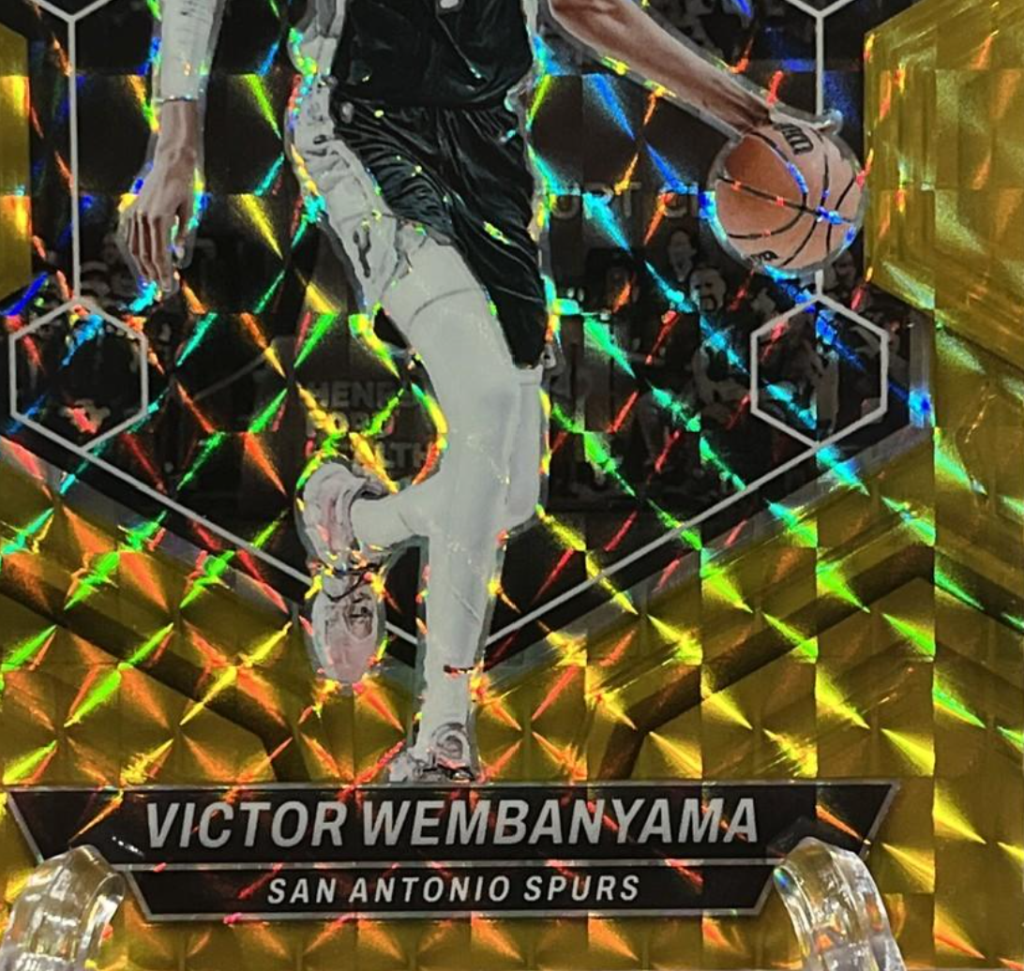
Holographic vs. Foil Trading Cards: Finishes Explained
Holographic & Foil Trading Card Finishes: The Complete Collector’s Guide
Few things capture the excitement of collecting sports cards quite like pulling a card that shines differently from everything else in the pack.
Maybe it’s a baseball card with a rainbow holographic effect. A football rookie card featuring reflective gold foil. A basketball parallel with a cracked ice pattern. Or a rare Refractor that changes appearance as you tilt it under the light.
These premium finishes have become an important part of modern trading card collecting.
But what exactly is the difference between holographic and foil trading cards? Are Refractor cards holographic? What makes Chrome cards different? And do premium finishes actually make sports cards more valuable?
Whether you’re collecting baseball, football, basketball, soccer, hockey, Pokémon, or personalized sports cards, understanding card finishes can help you identify what you own, recognize special variations, and make more informed collecting decisions.
This complete guide explores the most popular holographic and foil trading card finishes, how they work, what makes them collectible, and how similar effects can be used to create professional-quality custom trading cards.
What Are Holographic and Foil Trading Card Finishes?
Holographic and foil trading card finishes are decorative materials or printing effects that create reflective, metallic, patterned, or color-shifting surfaces on collectible cards. Foil finishes typically produce metallic shine, while holographic finishes use optical patterns that create changing colors or visual effects when viewed from different angles.
These finishes are commonly found on sports cards, trading card game collectibles, limited-edition releases, inserts, parallels, and premium custom trading cards.
The terms are sometimes used interchangeably, but they can describe different printing materials and visual characteristics.
Quick Answer: Holographic vs. Foil Trading Cards
The main difference between holographic and foil trading cards is the visual effect. Metallic foil generally creates a reflective silver, gold, or colored surface. Holographic foil produces rainbow-like or patterned optical effects that change as the card moves under light.
Both finishes can be used on standard cards, rare parallels, or limited editions.
A shiny card is not automatically rare, and a holographic card is not necessarily serial numbered.
What Is a Holographic Trading Card?
A holographic trading card is a collectible card featuring a holographic or holographic-style material that creates changing reflective patterns or colors.
When the card is tilted under a light source, portions of its surface may appear to shift through different colors or display distinctive optical patterns.
These effects can create the appearance of movement, depth, or a rainbow sheen.
Holographic finishes are used across sports cards, trading card games, and custom collectibles.
How Do Holographic Trading Cards Work?
Many commercial holographic card finishes use specialty films or foils with microscopic surface patterns.
These structures interact with light to create colorful optical effects.
When the viewing angle changes, the visible colors or reflective patterns can change as well.
Although the term “holographic” is commonly used throughout the hobby, not every holographic-looking card contains a true three-dimensional hologram.
Some use diffractive foils, patterned films, reflective coatings, or other optical technologies.
For collectors, the most recognizable feature is the dynamic appearance of the card under different lighting conditions.
Why Do Collectors Like Holographic Cards?
Holographic finishes have several appealing characteristics.
Visual excitement: Reflective rainbow effects make cards stand out within a collection.
Distinctive designs: Holographic treatments can make familiar player artwork appear dramatically different.
Collecting variety: Manufacturers can create multiple versions of the same card using different foil patterns or finishes.
Display appeal: Holographic cards can look especially impressive in protective cases or under carefully positioned lighting.
Personal connection: A favorite athlete’s card may feel even more special when presented with a premium finish.
These features help explain why holographic trading cards remain popular among collectors.
What Is a Foil Trading Card?
A foil trading card is a collectible card that incorporates a thin decorative metallic or reflective layer to enhance its appearance.
Foil effects may appear across the entire card or in selected areas, such as player names, borders, logos, backgrounds, and other design elements.
Gold, silver, copper, and colored metallic foils are common examples.
Foil finishes can give a trading card a polished, reflective appearance that differs from ordinary printed ink.
What Is Foil Stamping on Trading Cards?
Foil stamping is a finishing process that transfers a thin decorative foil to selected parts of a printed surface, commonly using a stamping die, heat, and pressure.
For trading cards, foil stamping may be used to highlight names, logos, edition numbers, borders, or decorative artwork.
Other production methods can also create metallic effects, including specialized films, laminates, and metallic substrates.
Not every shiny card is hot-foil stamped.
What Are the Most Common Foil Colors?
Popular metallic finishes include:
- Gold foil
- Silver foil
- Copper foil
- Red metallic foil
- Blue metallic foil
- Green metallic foil
- Purple metallic foil
- Rainbow or multicolor specialty foil
The exact color and visual appearance depend on the materials and production method.
Holographic vs. Foil Trading Cards: What’s the Difference?
Although holographic and metallic foil finishes can both make cards reflective, their visual appearances are not identical.
| Feature | Holographic Finish | Metallic Foil Finish |
|---|---|---|
| Main appearance | Rainbow or patterned optical effects | Metallic shine |
| Color movement | Often changes with viewing angle | Usually retains a dominant metallic color |
| Common effects | Rainbow, prismatic, patterned holographic | Gold, silver, copper, metallic colors |
| Application | Full card or selected areas | Full card or selected areas |
| Use on parallels | Common | Common |
| Always serial numbered? | No | No |
| Automatically valuable? | No | No |
| Suitable for custom cards? | Yes, when supported | Yes, when supported |
A holographic finish can itself be manufactured using foil materials, so these categories are not always mutually exclusive.
The most important distinction is the intended visual effect.
Foil generally emphasizes metallic reflection. Holographic treatments emphasize optical color shifts or patterns.
What Are Rainbow Holographic Trading Cards?
Rainbow holographic trading cards feature reflective finishes that display multiple colors as the card is moved under light.
These effects may appear across the card background, portions of the artwork, or the entire visible surface.
A rainbow finish can create a dynamic appearance without requiring a completely different card design.
Are Rainbow Holographic Cards Rare?
Not necessarily.
A rainbow holographic finish describes appearance, not production quantity.
Some rainbow holographic cards are widely distributed, while others belong to scarce parallels or special limited editions.
Collectors should check the product checklist, parallel name, and
before assuming a rainbow card is rare.
Are Rainbow Holographic and Rainbow Foil the Same?
The terms can overlap, but manufacturers may use them to describe different materials or product variations.
A “Rainbow Foil” card might refer to a specific named parallel rather than every card displaying rainbow-colored reflections.
For accurate identification, use the manufacturer’s official parallel name whenever possible.
What Are Cracked Ice Trading Cards?
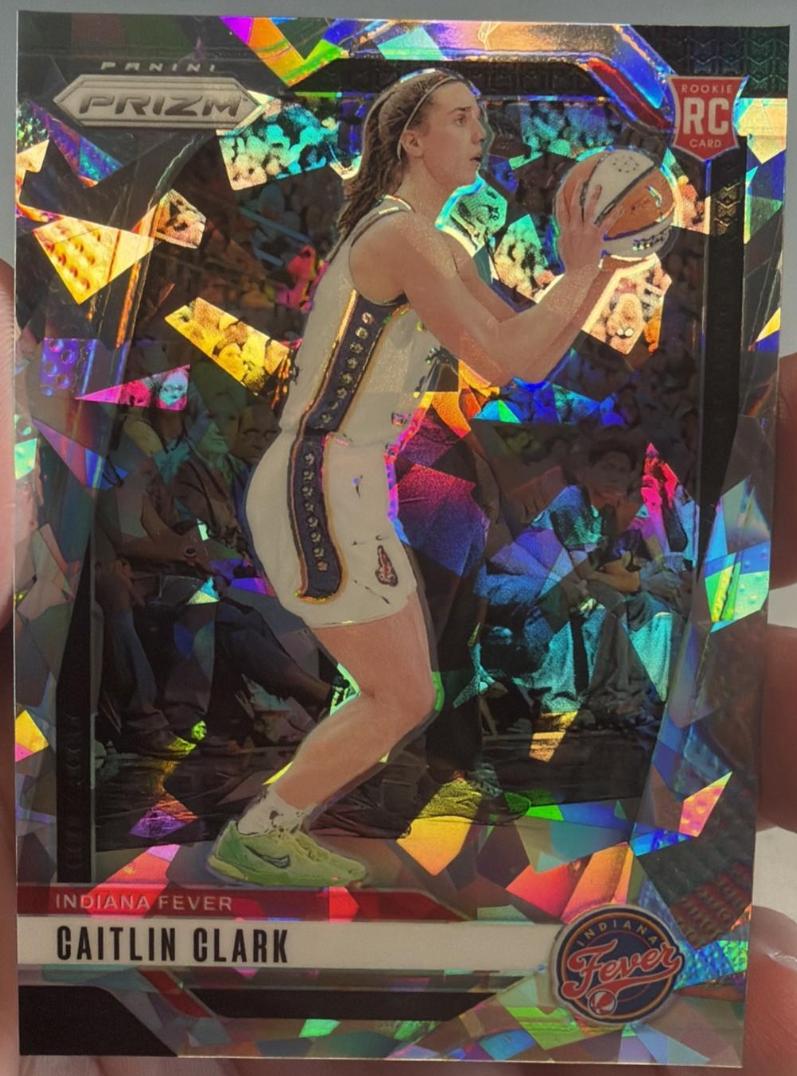
Cracked ice trading cards feature a reflective pattern resembling fractured ice, broken glass, or irregular geometric shards.
The pattern creates multiple reflective surfaces that catch light from different angles.
Cracked ice is a popular appearance in modern sports card collecting and can be especially striking when combined with player photography and bold card artwork.
Why Is It Called Cracked Ice?
The name comes from the fragmented visual pattern.
Rather than showing a continuous rainbow effect, a cracked ice finish has an angular texture resembling pieces of frozen or shattered material.
Are Cracked Ice Cards Rare?
Some cracked ice parallels are produced in limited quantities, but others may be more widely available.
The design alone does not establish rarity.
A cracked ice card numbered to 10 has a clearly stated edition size of 10, while an unnumbered cracked ice card does not provide that same production information.
Edition sizes and scarcity vary by product.
Cracked Ice vs. Rainbow Holographic Cards
Rainbow holographic finishes generally emphasize continuous color shifts or flowing optical reflections.
Cracked ice finishes emphasize a recognizable fractured geometric pattern.
Both can produce colorful reflective effects, but their textures and visual presentation are different.
What Are Chrome Trading Cards?
Chrome trading cards are collectibles manufactured using a metallic-looking card substrate or other reflective construction associated with Chrome-style products.
Within sports collecting, Topps Chrome and Bowman Chrome are among the best-known product families featuring this appearance.
Chrome cards typically have a smooth, highly reflective finish that differs from traditional paper-based cards.
Are Chrome Cards Holographic?
Not always.
A standard Chrome card can have a mirror-like or metallic appearance without being a Refractor or another rainbow-effect parallel.
The specific card type depends on the manufacturer’s product.
A card may be reflective because of its Chrome construction while lacking the color-shifting characteristics of a special parallel.
What Is the Difference Between Chrome and Foil Cards?
Chrome generally describes a particular category of reflective card construction or branded product technology.
Foil is a broader term referring to metallic or reflective materials used during card production.
Some Chrome-style cards use metallic or foil-based materials, but not every foil card is a Chrome card.
What Is a Refractor Trading Card?
A Refractor is a collectible card variation associated with Topps products that uses specialized reflective technology to produce a distinctive rainbow-like appearance when viewed under light.
Refractors are particularly recognizable in Topps Finest and Topps Chrome collecting.
A Refractor may resemble the standard Chrome version of a card, but its reflective treatment creates additional color-shifting effects.
What Is the Difference Between a Refractor and a Holographic Card?
A Refractor is a specific trading card product term, while holographic is a broader description of an optical finish.
Both may feature colorful reflections, but collectors should not assume that every holographic card is officially a Refractor.
The appropriate identification depends on the manufacturer and the product checklist.
What Are Colored Refractors?
Colored Refractors are alternate card variations that combine Refractor-style visual effects with a distinctive color.
Examples may include blue, green, gold, orange, red, or other versions, depending on the specific product.
Some colored Refractors are serial numbered, while others may not be.
Collectors should verify the edition size using the official product checklist.
What Is a Superfractor?
A Superfractor is a premium Topps parallel typically associated with an extremely limited edition, often a one-of-one card.
Superfractors are known for distinctive gold-toned reflective patterns.
However, collectors should confirm the official set details and numbering for any specific card.
What Is the Difference Between Refractor, Prizm, and Holo Cards?
These names can describe visually related effects, but they are not interchangeable across trading card manufacturers.
For example, Topps uses Refractor terminology in its Chrome-related products.
Panini uses Prizm terminology for certain collectible products and parallels.
Holo may be used by other products to describe a specific reflective variation.
Collectors should identify cards using the terminology established by the manufacturer.
Using the correct name matters when researching card values, checking population reports, building player collections, or listing cards for sale.
What Are the Most Popular Trading Card Finishes?
Modern collectors may encounter a wide range of finishes and visual effects.
The following table highlights common categories.
| Card Finish | Typical Appearance | Collector Appeal |
|---|---|---|
| Standard gloss | Smooth, shiny coating | Clean presentation |
| Matte | Nonreflective or subdued surface | Classic appearance |
| Metallic foil | Gold, silver, or colored shine | Premium metallic look |
| Rainbow holographic | Multicolor reflective shifts | Bright, dynamic appearance |
| Cracked ice | Fragmented reflective pattern | Distinctive visual texture |
| Chrome-style | Smooth metallic reflection | Modern sports card look |
| Refractor-style | Rainbow-like color movement | Familiar hobby aesthetic |
| Patterned holographic | Geometric, wave, or other optical pattern | Visual variety |
| Embossed foil | Raised or textured foil elements | Dimensional presentation |
| Specialty iridescent | Angle-dependent color shifts | Premium optical effect |
Specific names, materials, and production processes differ by manufacturer.
A finish category should not be mistaken for an official rarity classification.
Do Holographic and Foil Finishes Make Trading Cards More Valuable?
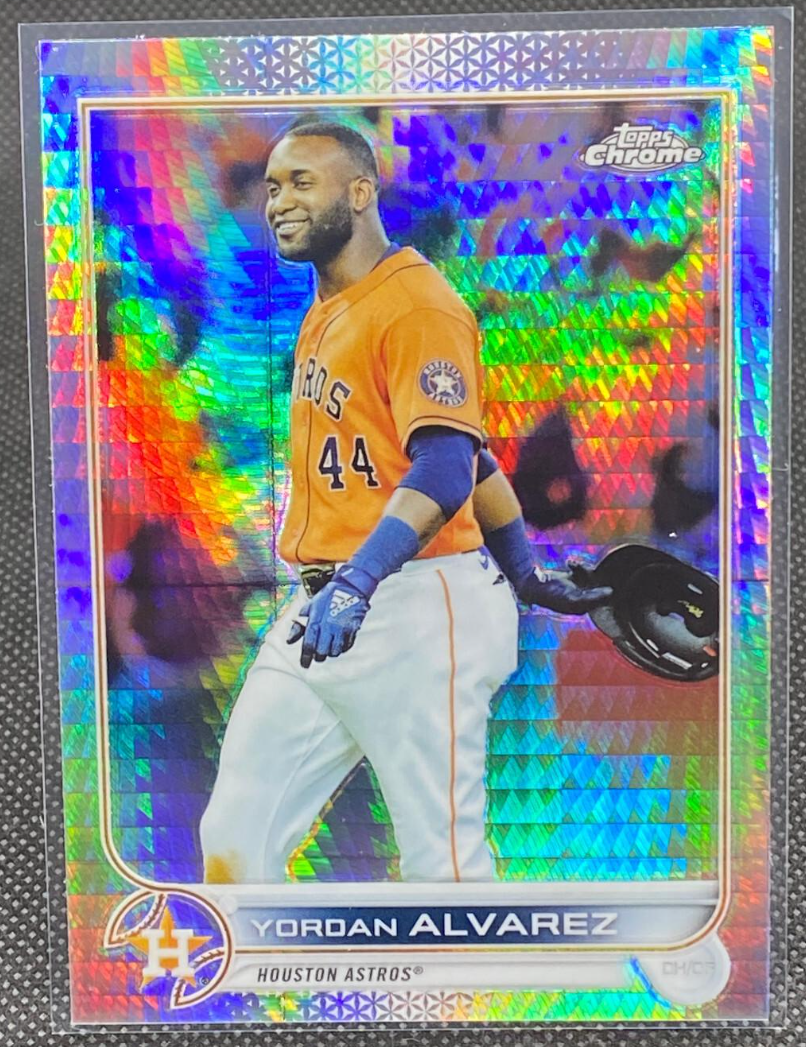
Holographic and foil finishes can increase a trading card’s desirability, but they do not automatically make it more valuable. Collector demand, player popularity, scarcity, product reputation, condition, and comparable sales are typically more important than the reflective finish alone.
For example, a limited gold parallel featuring a highly collected rookie might attract strong demand.
A common holographic card featuring a relatively unpopular subject may have little resale premium.
The finish contributes to a card’s appearance and identity, but does not establish market value by itself.
What Factors Affect the Value of Foil and Holographic Cards?
Player or character popularity: Demand for the featured subject influences collector interest.
Parallel scarcity: A numbered parallel limited to 25 copies may be more desirable than a more common version of the same card.
Manufacturer and product: Established releases often have recognizable collecting histories.
Condition: Scratches, surface damage, corners, and centering can influence value.
Professional grading: Third-party grading may affect buyer confidence and market prices.
Design appeal: Certain finishes become favorites because collectors find them visually attractive.
Market demand: Actual completed sales provide stronger evidence of resale value than asking prices alone.
Are Gold Foil Cards More Valuable Than Silver Foil Cards?
Not always.
In some product lines, gold parallels are produced in smaller quantities than silver versions and may command higher prices.
In other products, gold or silver simply identifies the design finish without indicating a specific rarity level.
Always verify the manufacturer’s parallel checklist and production information.
Are All Holographic Trading Cards Serial Numbered?
No.
Holographic refers to the card’s optical appearance.
Serial numbering refers to the number of copies produced within a defined edition.
The two features are independent.
For example, a manufacturer might release an unnumbered holographic base card, a rainbow parallel, a gold parallel numbered to 50, and a one-of-one premium card.
All could contain reflective effects, but their edition sizes would differ.
What Does /99 or /25 Mean on a Holographic Trading Card?
A card marked 15/99 represents copy 15 from a specific edition of 99.
A card marked 07/25 represents copy seven from an edition of 25.
The denominator indicates the stated production quantity for that numbered version.
The reflective finish does not change how serial numbering works.
For a deeper explanation, see our guide to What Are Serial Numbered Trading Cards?
How Can You Tell If a Trading Card Has a Holographic or Foil Finish?
Identifying a card’s finish often requires examining it under appropriate lighting and comparing it with an official checklist.
Step 1: Examine the Surface Under Light
Gently change the viewing angle while observing the reflective appearance.
A metallic foil area may produce a consistent metallic shine.
A holographic finish may reveal shifting colors or specialized patterns.
Step 2: Look for Distinctive Patterns
Rainbow effects, fractured geometric designs, and reflective borders can help distinguish card variations.
Step 3: Check the Back of the Card
Look for identifying information, including the manufacturer, product, card number, and any serial numbering.
Step 4: Consult the Official Checklist
Compare the card against the manufacturer’s published list of base cards, inserts, and parallels.
This is especially important because visually similar cards may have different official names.
Step 5: Compare Verified Examples
When possible, examine confirmed examples from reputable retailers, grading services, or collector resources.
Keep in mind that photographs may not accurately capture holographic patterns.
A card that appears silver in a photograph may display multiple colors when tilted under real lighting.
How Do You Protect Holographic and Foil Trading Cards?
Premium reflective finishes can be especially vulnerable to visible surface defects.
Scratches, fingerprints, pressure marks, and improper cleaning may affect the appearance and condition of a card.
Handle Cards Carefully
Avoid touching the printed surface unnecessarily.
Whenever possible, hold the card by its edges.
Use Appropriate Protective Sleeves
A clean, correctly sized protective sleeve can help reduce accidental surface contact.
For many standard trading cards, a soft card sleeve can be used before placing the card in a compatible rigid holder.
Avoid Abrasive Cleaning Materials
Do not attempt to polish reflective card surfaces with household cleaners or abrasive cloths.
Improper cleaning can leave permanent marks.
Store Cards in a Stable Environment
Avoid direct sunlight, excessive heat, high humidity, and conditions that could cause warping or discoloration.
Choose Suitable Display Protection
Protective cases and acrylic displays can help showcase valuable or meaningful cards.
Collectors should use holders appropriate for the card’s thickness and dimensions.
Can You Make Your Own Holographic Trading Cards?
Yes. Custom holographic trading cards can be professionally manufactured using personalized photographs, player information, artwork, and specialty reflective finishes. Available holographic effects vary by manufacturer and production method.
This brings one of the most visually exciting aspects of traditional sports card collecting to personalized collectibles.
A youth baseball player can have a holographic card featuring their own photo.
A high school football team can create coordinated reflective trading cards for its players.
A soccer league can offer personalized player cards with a premium collectible appearance.
Custom holographic cards are also suitable for gifts, school recognition, commemorative releases, special events, and other personal projects.
What Makes a Professional Custom Holographic Card?
Important considerations include:
High-quality photographs: Clear images contribute to a polished finished design.
Professional printing: Accurate colors and detailed artwork help maintain visual quality.
Appropriate specialty material: The holographic effect should complement the intended card design.
Consistent dimensions: Standard sports card proportions make cards easier to display and store.
Careful finishing: Clean edges and a consistent production process contribute to professional presentation.
Protective options: Card sleeves, rigid cases, and display slabs can help preserve the finished collectible.
Why Holographic Finishes Are Popular for Custom Youth Sports Cards
For many young athletes, owning a professional-looking trading card is an exciting experience.
Holographic finishes can make that experience even more memorable.
A youth hockey player can see their own image surrounded by colorful reflective effects.
A baseball player can receive a personalized card with the type of visual treatment familiar from premium sports card releases.
A basketball team can create a coordinated set of player cards that feels like a collectible series.
These custom cards are not meant to replace officially licensed professional sports cards.
Instead, they bring elements of the collecting experience to athletes and moments that traditional manufacturers may never feature.
NCASE CARDS: Custom Holographic Trading Cards for Every Athlete
At NCASE CARDS, we believe the excitement of owning a premium sports trading card should not be limited to professional athletes.
Our custom trading cards allow individuals, athletes, teams, leagues, schools, and organizations to create personalized collectibles featuring their own photos and information.
Personalized Holographic Sports Cards
NCASE CARDS offers custom holographic trading cards designed to bring professional-quality collectible presentation to personalized player cards.
Rainbow and Cracked Ice Effects
Available NCASE holographic treatments include rainbow and cracked ice-style effects, providing different reflective looks for custom card designs.
The NCASE Core Edition
The NCASE Core Edition combines a personalized holographic trading card with a customized acrylic slab and protective bumper frame.
This creates a complete display collectible suitable for individual athletes, gifts, team programs, and special occasions.
Custom Cards for Teams and Leagues
NCASE CARDS also supports group ordering for teams and leagues.
Organizers can create a group and share ordering links so participating families can personalize their own player’s cards.
This makes professional-quality custom cards more accessible for entire rosters and larger organizations.
Make Your Own Custom Trading Card
Whether you’re creating a card for your child, celebrating an athlete’s achievements, or organizing a collection for an entire sports team, NCASE CARDS helps turn meaningful moments into personalized collectibles.
Explore NCASE CARDS to create your own custom sports trading card.
Frequently Asked Questions About Holographic and Foil Trading Cards
What is a holographic trading card?
A holographic trading card features a specialty reflective finish that creates shifting colors, patterns, or optical effects when viewed under different lighting angles. Holographic finishes are used on sports cards, trading card game collectibles, and custom cards.
What is a foil trading card?
A foil trading card incorporates a metallic or reflective material to create a shiny appearance. Foil effects may cover the entire card or selected design elements such as names, borders, and logos.
What is the difference between holographic and foil trading cards?
Metallic foil generally creates a consistent gold, silver, or colored metallic reflection. Holographic finishes use optical patterns that produce changing colors or visual effects. Holographic materials may also be made using foil.
Are holographic cards better than regular cards?
Holographic cards may offer greater visual appeal, but they are not automatically better or more valuable. Personal preference, card quality, rarity, condition, and collector demand determine which version is more desirable.
Are holographic trading cards rare?
Some are rare, while others are common. A holographic finish describes how the card looks, not how many copies were produced.
Are foil cards worth money?
Some foil cards can be valuable, especially rare parallels, popular rookie cards, and desirable autographs. However, metallic foil alone does not establish resale value.
What is a cracked ice trading card?
A cracked ice trading card features a reflective pattern resembling fractured ice or geometric shards. It is a popular visual effect used on certain sports card parallels and custom collectibles.
Are cracked ice cards rare?
Rarity depends on the specific product and edition size. Some cracked ice cards are serial numbered, while others are not.
What is a rainbow holographic trading card?
A rainbow holographic trading card uses an optical finish that displays changing rainbow-like colors when the card is tilted under light.
What is a Refractor card?
A Refractor is a trading card variation associated with Topps products that uses specialized reflective technology to produce rainbow-like visual effects. Refractors are especially well known in Chrome-related sports card sets.
What is the difference between Chrome and Refractor cards?
Chrome describes a reflective card construction or product family, while Refractor identifies a particular type of parallel with enhanced optical effects. A standard Chrome card is not automatically a Refractor.
Are Prizm cards holographic?
Some Panini Prizm cards and parallels feature reflective or rainbow-like effects. However, Prizm is a manufacturer-specific product and parallel term, not simply a universal synonym for holographic.
Are holographic trading cards serial numbered?
Some are, but many are not. Serial numbering is a separate feature identifying an edition’s production quantity.
What does /99 mean on a holographic sports card?
A marking such as 25/99 identifies copy 25 from a numbered edition of 99. It represents the card’s stated print run for that specific version.
Is gold foil better than silver foil?
Not automatically. Gold and silver may indicate different rarity tiers in certain products, but in other cases they are simply decorative finishes. Collectors should verify the official checklist.
Can you make custom holographic baseball cards?
Yes. Professional custom card providers can create personalized baseball cards with player photographs, names, jersey numbers, team information, and available holographic finishes.
Can you make holographic football trading cards?
Yes. Custom holographic football cards can feature youth, high school, recreational, and other athletes using personalized photographs and player details.
Can youth sports teams order holographic trading cards?
Yes. Teams and leagues can organize custom holographic trading card orders. NCASE CARDS offers group ordering options that allow participating families to personalize individual player cards.
Can you make custom cracked ice trading cards?
Yes. Certain custom card manufacturers offer cracked ice-style holographic effects. NCASE CARDS includes cracked ice among its available holographic treatments.
How do you protect holographic trading cards?
Use appropriate sleeves and protective holders, handle cards by their edges, and avoid abrasive cleaning, direct sunlight, extreme temperatures, and excessive humidity.
Are custom holographic cards professionally graded?
Some custom cards may qualify for third-party grading, depending on the grading company’s acceptance policies. A protective acrylic slab is not the same as professional grading or authentication.
Where can I order professional-quality custom holographic trading cards?
Custom holographic sports cards can be ordered from specialized providers such as NCASE CARDS, which offers personalized player designs, premium holographic finishes, and collectible presentation options.
Final Thoughts: Why Holographic and Foil Trading Card Finishes Matter
Holographic and foil finishes have helped transform trading cards from simple printed collectibles into visually distinctive pieces of sports memorabilia and collectible artwork.
For traditional collectors, they create opportunities to chase special parallels, appreciate unique designs, and build collections around favorite athletes.
For fans of premium card design, metallic foil, Chrome-style surfaces, Refractors, rainbow holographic finishes, and cracked ice patterns offer different visual experiences.
And for custom trading card enthusiasts, these finishing technologies create exciting possibilities for personalized collectibles.
Ultimately, a great trading card combines the subject, design, quality, and story behind the collectible.
At NCASE CARDS, we believe every athlete deserves the opportunity to see their story brought to life on a professional-quality card.
Your Game. Your Story. Your Card.
NCASE the Moment.

How to Make Custom Trading Cards for Your League
How to Make Custom Trading Cards for Your League: The Complete Guide
Imagine every athlete in your youth sports league having their own professional-quality trading card.
Every baseball player. Every football athlete. Every soccer player, basketball player, or hockey player. Each with a personalized card featuring their photograph, name, jersey number, team colors, and player information.
Now imagine making that happen across an entire league without requiring your commissioners, coaches, or volunteers to individually collect hundreds of photographs, design every card, and manage payments from every family.
That’s the opportunity custom sports league trading cards can offer.
Personalized trading cards are more than individual keepsakes. They can become league-wide collectibles that celebrate every athlete, strengthen community connections, create memorable experiences, and support fundraising initiatives.
But how do you organize custom trading cards for an entire sports league? How do you handle multiple teams and age divisions? Can parents create their own cards? And how much work does the league administrator actually have to do?
This comprehensive guide explains how to create personalized trading cards for an entire youth sports league, from initial planning and design to ordering, production, distribution, and fundraising.
How Do You Make Custom Trading Cards for an Entire Sports League?
To make custom trading cards for an entire sports league, choose a provider that supports group ordering, organize your participating teams, establish a consistent card design, distribute ordering links, and allow families to personalize individual player cards. A centralized league ordering system can simplify administration while giving every athlete their own collectible.
With NCASE CARDS, league organizers can set up their league online, share ordering links with participating teams and families, and let parents upload their own player’s photograph and information.
Eligible group orders can then be coordinated for delivery to the designated coach or administrator.
This creates a scalable approach for organizations managing multiple teams, age groups, and divisions.
How to Create Custom League Trading Cards in 4 Easy Steps
Step 1: Create Your League
Begin by setting up your sports league through the NCASE CARDS online group ordering process.
Provide the necessary league information and organize the participating teams according to the available setup options.
Whether your organization consists of a handful of recreational teams or a larger multi-division league, the first step is establishing a central starting point for the card program.
Step 2: Share Your League’s Ordering Links
Once the league and participating teams are set up, distribute the appropriate ordering links through your coaches, team managers, or league communication channels.
Families can access the ordering experience without the league having to manually collect every player’s information.
Links can be shared through team emails, league announcements, registration communications, or approved parent messaging platforms.
Step 3: Parents Create Their Own Player Cards
Each participating family uploads its favorite athlete photograph and enters the personalized information required for the card.
This may include the player’s name, jersey number, team name, position, and other supported details.
Families complete their own personalization and ordering.
The league does not need to assign a volunteer to design hundreds of individual cards.
Step 4: Cards Are Produced and Shipped for Distribution
Once orders are submitted, the cards move through production.
Eligible group orders can be coordinated for delivery to the designated coach or administrator, who can distribute them to participating families.
For larger leagues, organizers should confirm team-level shipment arrangements and production deadlines before launch.
One league. Every team. Every player with a card worth keeping.
What Are Custom Sports League Trading Cards?
Custom sports league trading cards are personalized collectible cards produced for athletes participating in an organized sports league, often using coordinated designs across multiple teams or divisions.
Each athlete has an individual card, while shared league or team elements connect the cards into a larger collection.
For example, a youth baseball league with 15 teams could create a coordinated collectible series representing all participating players.
A recreational soccer organization might offer matching trading card layouts across several age divisions, with each team’s colors and player information personalized.
A youth hockey league could create cards for players in its house league, travel programs, or seasonal tournaments.
The goal is to bring the collecting experience associated with professional sports cards to an entire organization.
What Information Can Be Included on League Trading Cards?
Depending on the provider and selected design, custom league cards may feature:
- Player name and photograph
- Team name and approved team logo
- League name
- Jersey number
- Playing position
- Team colors
- Season or year
- Division or age group
- Player achievements or other supported information
- Premium holographic effects
- Personalized collectible presentation
A consistent league design can help connect cards across an organization while still allowing each team to maintain its own identity.
Can You Create Trading Cards for Multiple Teams in One League?
Yes. A custom trading card program can be organized across multiple teams, age divisions, and playing levels.
This is one of the major differences between making cards for a single sports team and planning a league-wide program.
A single team might need cards for 12 to 25 players.
A larger league may have hundreds of participants distributed across many rosters.
Successful league programs need a process that can scale without requiring administrators to manage every individual card.
Example: A Youth League with 20 Teams
Consider a hypothetical youth sports league with 20 teams and 15 players per team.
| League Detail | Example |
|---|---|
| Participating teams | 20 |
| Average players per team | 15 |
| Total eligible players | 300 |
| Player photos to collect manually | 300 |
| Individual designs to manage manually | 300 |
| Individual family payments to coordinate manually | Up to 300 |
If every family orders one card, the program could involve 300 personalized cards.
With a manual ordering approach, the league or its coaches may be responsible for collecting hundreds of photographs, checking information, organizing payments, and managing individual designs.
With self-service family ordering, each participating household handles its own personalization and purchase.
The league’s primary responsibilities become communicating the program, organizing participating teams, establishing deadlines, and coordinating distribution.
This can significantly reduce administrative workload.
What Is the Easiest Way to Organize League-Wide Trading Card Orders?
For a large youth sports organization, the easiest approach is often a group ordering platform that supports independent family customization.
Instead of requiring one administrator to oversee every individual transaction, families access the appropriate card ordering experience and complete their own orders.
Traditional League Ordering vs. Self-Service Parent Ordering
| Task | Manual League Ordering | Self-Service League Ordering |
|---|---|---|
| League setup | Administrator | Administrator |
| Team coordination | Administrator or coaches | Administrator or coaches |
| Player photographs | Collected centrally | Uploaded by each family |
| Player information | Entered manually | Entered by each family |
| Card personalization | Managed centrally | Managed by families |
| Individual payments | May require collection | Completed by families |
| Distribution | Organized by league | Group delivery can be coordinated |
| Corrections | Managed through administrator | Families review their own details |
Self-service ordering does not remove every responsibility from the league, but it can reduce repetitive administrative tasks.
For leagues run by volunteer commissioners, coaches, and parents, this can make the difference between a complicated project and a manageable seasonal program.
How Do You Keep League Trading Cards Consistent Across Different Teams?
A successful league-wide trading card collection should balance two goals.
First, every athlete should have an individual card that represents them.
Second, the cards should look like they belong to the same organization.
Create a Recognizable League Design
A league might establish a common card layout featuring a consistent border structure, typography, background treatment, and season identifier.
This gives the collection a recognizable visual identity.
Allow Team-Specific Colors
Individual teams can retain their identities through different colors, photos, and approved logos.
For example, one soccer league could have a common card layout while its participating teams use red, blue, green, and gold color variations.
Standardize Player Information
Establishing consistent information fields helps create a professional-looking collection.
Typical fields include player name, team, jersey number, position, and season.
Certain sports may require additional details, while others may use fewer fields.
Maintain Consistent Printing Quality
All cards should meet the agreed printing specifications for dimensions, image quality, finish, and production consistency.
A coordinated league collection looks more professional when the cards share predictable production standards.
What Are the Best Trading Card Options for Youth Sports Leagues?
Different leagues have different needs and budgets.
Some prioritize affordability so more families can participate.
Others want a premium commemorative product for a special season, championship, or anniversary.
Raw Custom Trading Cards
Raw cards are a practical option for leagues seeking an accessible player collectible.
These cards are provided without a dedicated acrylic display slab and can be suitable for team sets, trading, giveaways, or multi-card purchases.
Holographic League Trading Cards
Holographic finishes can make league trading cards especially appealing to young collectors.
Reflective surfaces and colorful effects bring some of the excitement of modern collectible sports cards to personalized player cards.
NCASE Core Edition
The NCASE Core Edition combines a personalized holographic card, a customized acrylic slab, and a protective bumper frame.
This option is ideal for families seeking a premium display collectible.
For leagues, offering different product options can help accommodate different budgets and preferences.
Which Option Is Better for a League?
| Consideration | Raw Cards | Premium Core Edition |
|---|---|---|
| Personalized player information | Yes | Yes |
| Available holographic finishes | Depending on option | Included |
| Protective acrylic slab | No | Yes |
| Customized slab label | No | Yes |
| Suitable for team collections | Yes | Yes |
| Premium display presentation | Optional separately | Included |
| Budget | Generally lower | Generally higher |
A league may choose to offer one option or allow families to select from available products.
How Much Does It Cost to Make Custom Trading Cards for an Entire League?
The cost of custom league trading cards depends on the number of participating athletes, product type, printing finish, order quantity, customization requirements, and shipping arrangements.
Larger orders may qualify for discounted pricing, but administrators should distinguish between the number of eligible athletes and the number of actual purchases.
For example, a league with 500 registered players does not necessarily generate 500 card orders.
Participation depends on family interest, program structure, product pricing, and the ordering deadline.
Should a League Pay for Every Card or Let Parents Order Individually?
There are two common approaches.
League-sponsored program: The league purchases a card for each participating athlete, potentially including the cost in registration fees or a separate approved budget.
Optional family purchase: Families choose whether to order and pay for their own player’s cards.
The first approach can create broader participation when adequately funded.
The second approach reduces the amount of money the league must collect and commit in advance.
NCASE CARDS’ family ordering model is designed to make independent player purchases easier to coordinate.
How Can League Administrators Estimate the Budget?
Use the following planning formula:
Estimated program product cost = expected number of cards ordered × per-card price
For an optional program, expected participation should be estimated realistically rather than assuming every registered family will purchase.
Administrators should also account for shipping, optional product upgrades, artwork requirements, and any applicable taxes.
Do Leagues Qualify for Bulk Discounts?
Many custom card providers offer volume pricing.
NCASE CARDS offers group pricing opportunities for qualifying team and league orders.
The available discount depends on the current program, product selection, and applicable order requirements.
League administrators should request current pricing before announcing a promotional price to families.
Can Sports Leagues Use Custom Trading Cards for Fundraising?
Yes. Custom league trading cards can be used as part of a sports league fundraising program, allowing organizations to offer personalized collectibles while generating proceeds under an agreed fundraising arrangement.
Unlike generic fundraising merchandise, a personalized player card features someone directly connected to the family purchasing it.
That personal connection can make trading cards a compelling product for youth sports fundraising.
How Could a League Trading Card Fundraiser Work?
A league could establish a program with a custom card provider, select the products to offer, and agree on a fundraising model.
For example, a youth baseball league might promote personalized player cards during registration or picture day.
Participating families would have the opportunity to purchase cards as keepsakes.
A defined contribution from qualifying sales could support league operations, equipment, scholarship programs, or other approved needs.
The specific contribution, pricing, payment process, and accounting responsibilities should be confirmed before launch.
What Can League Fundraising Proceeds Support?
Depending on the organization’s needs and applicable rules, funds might support:
- Equipment and uniforms
- League registration assistance
- Tournament expenses
- Field and facility improvements
- Travel support
- Scholarships and financial assistance
- Awards and recognition programs
- Community events
Custom card fundraisers should be structured transparently, with clear information about prices, participation, and how proceeds are used.
Why Can Trading Cards Work Well for League Fundraising?
The product is connected to the participants themselves.
Parents receive a personalized collectible featuring their child.
Athletes receive something they may enjoy sharing or trading.
The league has an opportunity to create a fundraising experience that reinforces its community identity.
Can Youth Sports Leagues Create Collectible Team Sets?
Yes. Instead of offering only individual player cards, a league can organize coordinated collections representing complete teams or divisions.
For example, a basketball team might create a set of cards featuring every rostered player.
A baseball division could produce cards for each participating team.
An entire soccer league might organize its collection by age division.
How Are Team Sets Different from Individual Cards?
An individual custom trading card focuses on one athlete.
A team set includes cards representing multiple players, typically using matching or coordinated designs.
League-wide sets can extend this concept across an entire organization.
The practical challenge is organizing participation, available copies, ordering, and distribution.
Administrators should work with their chosen provider to determine whether team sets, multiple copies, or special packaging are supported.
Can League Trading Cards Include Coaches, Mascots, and Volunteers?
Yes. Custom trading card programs do not have to be limited to players.
Depending on the project and provider, an organization could create cards celebrating:
- Head coaches and assistant coaches
- League commissioners
- Team mascots
- Long-serving volunteers
- Championship teams
- Special award recipients
- Retiring administrators
- Community sponsors
These cards can become part of a larger commemorative collection or recognition program.
For example, a league celebrating its 25th anniversary might create a special card honoring a longtime volunteer.
This gives organizations another way to recognize the people who help make their programs possible.
What Sports Can Have Custom League Trading Cards?
Custom league trading card programs can be created for a wide range of sports and organizations.
Youth Baseball Leagues
Custom baseball league cards are suitable for organizations affiliated with Little League Baseball, PONY Baseball, Babe Ruth League, Cal Ripken Baseball, USSSA Baseball, and other youth baseball programs.
Teams can create personalized cards with consistent designs, player photographs, and league information.
Youth Football Leagues
Pop Warner football programs, youth tackle football leagues, recreational flag football leagues, and school football organizations can create personalized player cards across multiple teams.
Youth Soccer Leagues
AYSO, American Youth Soccer Organization programs, US Youth Soccer, US Club Soccer, and recreational soccer leagues can offer coordinated player cards across age divisions.
Youth Basketball Leagues
AAU basketball programs, YMCA recreational leagues, i9 Sports programs, school leagues, and travel basketball organizations can use personalized trading cards to recognize participants.
Youth Hockey Leagues
House hockey leagues, travel hockey organizations, recreational hockey programs, and youth hockey associations can create coordinated cards for multiple teams.
Other Sports and Activities
Custom league trading cards can also be created for softball, volleyball, lacrosse, wrestling, cheerleading, swimming, gymnastics, martial arts, and other organized activities.
A league does not need to be professionally affiliated or nationally recognized to create a personalized collectible program.
When Should a Sports League Launch Its Trading Card Program?
Timing can affect participation, logistics, and distribution.
League administrators should select a program window that gives families enough time to submit photographs, personalize cards, and complete purchases before the desired event or distribution date.
Beginning of the Season
A league may introduce custom trading cards during registration or the opening weeks of the season.
This can help build anticipation and provide families with a unique seasonal collectible.
League Picture Day
Picture day can be a natural opportunity to introduce a trading card program.
Families may already be thinking about photographs and player keepsakes.
However, administrators should confirm that they have the appropriate rights and permissions to use any professional photographer’s images.
Midseason Fundraising
A league could introduce personalized cards during an established fundraising campaign.
End-of-Season Celebrations
Cards can serve as keepsakes for banquets, closing ceremonies, team celebrations, and award presentations.
Championship Tournaments
Special cards can commemorate tournaments, championship teams, and notable milestones.
How Far in Advance Should League Trading Cards Be Ordered?
Production timelines vary by manufacturer, quantity, product options, and shipping requirements.
NCASE CARDS generally estimates 10 to 15 business days for standard card production, with shipping transit additional.
Large league projects or special releases may require additional coordination.
For league-wide distribution, allow extra time for families to complete their orders and for organizers to resolve any missing or incorrect information.
How Can Leagues Protect Player Information and Photos?
When working with youth athletes, photograph permissions and data handling deserve particular attention.
League administrators should establish a clear policy for submitting player images and personal details.
Obtain Appropriate Photo Permissions
Ensure that families have the right to use and submit the photographs they upload.
If photographs were taken by a professional photographer, confirm any licensing or usage restrictions.
Minimize Personal Information
Only collect the information needed to create the card.
For youth athletes, avoid unnecessary sensitive details such as home addresses, personal telephone numbers, private school schedules, or other information unrelated to the collectible.
Explain Where Cards May Appear
Families should understand whether the card is intended for private distribution, a public league collection, or promotional use.
Public promotional use should be addressed separately from simply purchasing a card for personal enjoyment.
Establish Clear Ordering Deadlines
A clearly communicated deadline can help administrators organize submissions, reduce late changes, and plan distribution.
Confirm Provider Policies
Review the card provider’s privacy policy, image-handling practices, and terms of service before launching a large program.
What Should a League Look for in a Custom Trading Card Company?
A league-wide program requires more than attractive card designs.
The provider must also support an ordering process appropriate for multiple teams and potentially hundreds of athletes.
Before choosing a manufacturer, ask the following questions:
Can the Provider Support Multiple Teams?
League administrators need a way to organize participating teams and avoid mixing information from unrelated rosters.
Can Parents Upload Their Own Photos?
Family-managed uploads can eliminate the need for a central administrator to collect hundreds of images.
Can Families Pay Individually?
Individual payments may simplify league accounting and reduce the need for coaches to collect money.
Are the Cards Professionally Manufactured?
Review samples, print quality, finishes, card materials, and available protective options.
Can the Design Remain Consistent Across Teams?
A coordinated visual identity makes a league-wide collection feel more cohesive.
Is Discounted Group Pricing Available?
Large organizations should ask about available volume discounts and any program-specific pricing requirements.
Can Orders Be Distributed by Team?
Confirm how orders are packaged, shipped, and organized for distribution.
Does the Provider Support Fundraising Programs?
If fundraising is a priority, discuss pricing structures and administrative requirements before launch.
Can the Manufacturer Meet the League’s Deadline?
Make sure the project schedule accounts for family ordering, production, quality control, and delivery.
Why Choose NCASE CARDS for Custom League Trading Cards?
At NCASE CARDS, we specialize in professional-quality personalized trading cards for athletes, teams, leagues, schools, and organizations.
We understand that creating trading cards for an entire league is different from ordering a single card.
League administrators need a process that is organized, accessible, and practical for groups of all sizes.
Designed for Groups and Organizations
Our online ordering process supports team and league programs, allowing organizers to create groups and share ordering links.
Personalized by Each Family
Families can upload their own player’s photograph and enter the personalized details for their card.
This reduces the need for administrators to collect and manage individual player information.
Professional Sports Card Presentation
NCASE CARDS offers personalized cards featuring professional printing and available holographic finishes.
Premium NCASE Core Edition
The NCASE Core Edition includes a personalized holographic trading card, a customized acrylic slab, and a protective bumper frame.
Options for Different Budgets
League programs can explore raw card and premium presentation options, depending on available products and pricing.
Coordinated Group Ordering
Eligible orders can be organized for shipment to designated coaches or administrators.
Bulk Pricing Opportunities
Qualifying group orders may be eligible for discounted pricing.
League Fundraising Possibilities
NCASE CARDS can also work with league organizers to discuss collectible programs that support fundraising objectives.
Whether your organization has five teams or fifty, the goal is the same: make personalized sports card collecting available to your athletes without overwhelming your administrators.
Explore custom league trading cards at NCASE CARDS.
Frequently Asked Questions About Custom League Trading Cards
How do you make custom trading cards for an entire youth sports league?
Choose a provider that supports league ordering, organize the participating teams, establish a coordinated design, and distribute ordering links. With NCASE CARDS, families can personalize and order individual player cards, reducing the need for administrators to manage every design.
Can a league create trading cards for multiple teams?
Yes. A league can coordinate personalized cards across multiple teams and age divisions. The exact team organization and fulfillment options depend on the provider.
What is the easiest way to make trading cards for hundreds of players?
Use a self-service ordering system where each family uploads its own photograph, enters player information, and completes its own purchase. This reduces the amount of manual administration required.
Can parents order their child’s card without going through the coach?
Yes. With a family ordering system, parents can access a shared link and submit their own player’s card information and order.
Do league commissioners need to collect every player’s photograph?
Not when using a platform that supports direct family photo uploads. Parents can submit their own images through the ordering process.
How much do custom trading cards cost for an entire league?
Cost depends on the number of cards ordered, product selection, finishes, packaging, and shipping. Volume pricing may be available for qualifying league programs.
Can parents pay for their own league trading cards?
Yes. Some providers, including NCASE CARDS, offer individual family ordering so the league does not need to collect payment from every participant.
Are custom trading cards available for Little League Baseball and Softball?
Yes. Custom baseball and softball cards can be created for Little League teams and other youth baseball organizations, subject to appropriate logo and photograph permissions.
Can Pop Warner football leagues make custom trading cards?
Yes. Pop Warner football organizations and other youth football leagues can create personalized cards featuring individual athletes and coordinated team designs.
Can AYSO soccer leagues create trading cards for every player?
Yes. AYSO and other youth soccer organizations can offer personalized soccer cards across multiple teams and divisions. Participation can be organized through a group ordering program.
Can AAU basketball organizations create custom league cards?
Yes. AAU basketball programs and other multi-team basketball organizations can create coordinated player cards for their participating athletes.
Can youth hockey leagues make custom trading cards?
Yes. Youth hockey leagues can organize personalized cards across house league teams, age divisions, and other participating groups.
Can league trading cards include team names, colors, and logos?
Yes. Custom cards can incorporate supported team details and designs. Organizations should obtain appropriate permission before using protected logos or artwork.
Can custom league trading cards have holographic finishes?
Yes. Some manufacturers, including NCASE CARDS, offer holographic custom trading card options.
Can every player have a different photo?
Yes. Each athlete can be featured on an individual card with their own photograph while sharing a common league or team design.
Are custom trading cards good for sports league fundraising?
They can be. Personalized cards may be sold through an organized program that directs an agreed portion of eligible proceeds toward league fundraising goals.
Can leagues create collectible team sets?
Yes. Coordinated cards can be organized into team collections or larger league collections, depending on the available production and packaging options.
Can coaches and mascots have their own cards?
Yes. Custom trading cards can celebrate coaches, mascots, volunteers, and other important members of a league.
Are custom league trading cards good end-of-season gifts?
Yes. Personalized trading cards are suitable for season-ending celebrations, banquets, championship recognition, and player appreciation.
How long does it take to produce custom trading cards for a league?
Production times vary. NCASE CARDS generally estimates 10 to 15 business days for standard production, followed by shipping. Large group projects may require additional planning.
Can a league create special limited-edition cards?
Depending on the manufacturer’s production capabilities, leagues may commission special designs or limited production runs for championships, anniversaries, or other events. Any serial numbering or edition limits should be verified with the provider.
Can a league use player photos taken on picture day?
Potentially, but the league or family must have permission to use the images for custom trading card production. Photography contracts may restrict reproduction.
How do league administrators distribute custom trading cards?
Distribution depends on the provider’s fulfillment options. Eligible NCASE group orders can be coordinated for delivery to designated coaches or administrators for local distribution.
Where can a youth sports league order custom trading cards?
Youth sports leagues can explore personalized player cards and group ordering through NCASE CARDS. Its ordering experience is designed to simplify card creation for teams, leagues, and other organizations.
Final Thoughts: Give Every Athlete in Your League Their Own Trading Card
The excitement of owning a trading card should not be reserved for professional athletes.
Every youth sports league is filled with players who practice, compete, build friendships, develop confidence, and create memories worth celebrating.
Custom league trading cards give organizations a way to recognize those moments.
For athletes, they offer the excitement of seeing themselves on a collectible.
For parents, they preserve a moment in their child’s sports journey.
For leagues, they create opportunities for community engagement, team recognition, and potential fundraising.
And with an organized self-service ordering process, league-wide programs do not have to create hundreds of additional tasks for volunteer administrators.
At NCASE CARDS, we believe every athlete has a story worth collecting.
One League. Every Team. Every Player. Their Own Card.
NCASE the Moment.
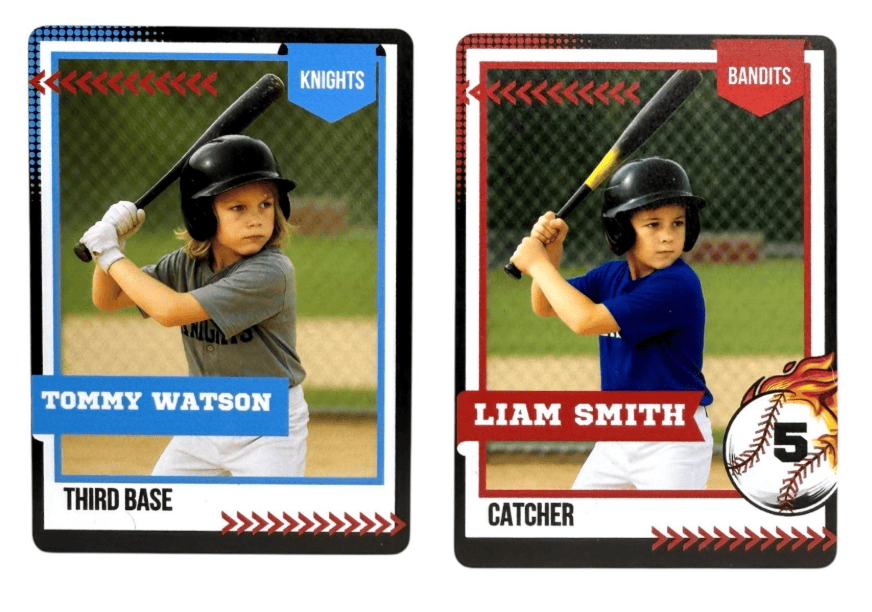
How to Make Custom Trading Cards for Your Team
How to Make Custom Trading Cards for Your Team: A Complete Guide
Imagine every player on your baseball, football, basketball, soccer, or hockey team having their own professional-quality trading card.
Not a basic team photograph. Not an ordinary printed keepsake. A personalized sports trading card featuring each athlete’s photo, name, jersey number, team colors, and player information.
Custom team trading cards bring the excitement of professional sports collecting to athletes of all ages. Players can collect their teammates, trade cards with friends, celebrate their accomplishments, and preserve memories of an unforgettable season.
But if you’re a coach, team parent, or league administrator, you might be wondering:
How do you create personalized trading cards for an entire team without spending hours collecting photos, organizing information, and designing individual cards?
The good news is that making custom sports trading cards for your team can be surprisingly simple.
In this guide, we’ll explain how to create custom team trading cards, what information you’ll need, how much they typically cost, which designs and finishes to consider, and how to simplify ordering for an entire roster.
How Do You Make Custom Trading Cards for a Sports Team?
To make custom trading cards for your team, choose a card provider, establish your team design, collect each player’s photo and information, customize the cards, and place your order. With a dedicated team ordering platform such as NCASE CARDS, coaches can simplify the process by creating a team, sharing one link, and allowing each family to design and order their own player’s card.
This eliminates much of the manual work associated with coordinating personalized products for an entire team.
Instead of one coach managing 20 or more individual designs, each participating family can complete its own customization.
How to Make Custom Team Trading Cards in 4 Easy Steps
NCASE CARDS has developed an online ordering process designed specifically for teams, leagues, schools, and other organizations.
Step 1: Create Your Team or League
Start by visiting NCASE CARDS and setting up your team or league.
Enter your organization and team information to begin the ordering process.
The initial setup can be completed in minutes, making it practical for individual sports teams and larger organizations.
Step 2: Share Your Team’s Ordering Link
Once your team is created, share the dedicated ordering link with your players and families.
The link can be distributed through email, group messages, team communication apps, or other channels.
Rather than collecting everyone’s information manually, the coach simply directs families to the same ordering experience.
Step 3: Each Family Designs Their Own Player’s Card
Parents or players can select their favorite athlete photograph and enter the personalized details for their card.
Depending on the available design options, these may include the player’s name, jersey number, position, and other information.
Each family is responsible for personalizing and ordering its own card.
Coaches do not need to collect every player’s photograph or create each individual design.
Step 4: Team Orders Are Shipped Together
Eligible team orders can be coordinated for shipment together to the designated coach or team administrator.
This simplifies distribution and helps keep the team’s custom cards organized.
The result is a coordinated team collection without requiring the coach to manage each personalized order individually.
One team. One shared link. Every player with their own card.
What Are Custom Team Trading Cards?
Custom team trading cards are personalized collectible sports cards featuring individual players within a coordinated team or league design. They typically include each athlete’s photograph, name, jersey number, team identity, and other information.
Unlike traditional sports cards featuring professional athletes selected by major manufacturers, custom team trading cards allow amateur, youth, school, and recreational athletes to have personalized cards of their own.
A youth baseball team might create a full roster of individual player cards.
A football program could develop cards for varsity and junior varsity athletes.
A recreational soccer league could offer a matching card design across multiple teams.
The goal is to give each participant a unique collectible while maintaining a consistent visual identity for the group.
What Information Goes on a Custom Sports Team Card?
Common details include:
- Player’s first and last name
- Favorite action photograph or portrait
- Team or school name
- Jersey number
- Playing position
- Team colors
- League name
- Season or graduation year
- Athlete achievements or personal information
- Custom artwork, approved logos, or special graphics
Not every provider supports every field, and some customization options may vary by sport or product.
The most important elements are a high-quality player photograph, an accurate name, and a consistent team design.
How Do You Design Custom Trading Cards for an Entire Team?
Creating team trading cards involves two design decisions: the overall team appearance and the information personalized for each player.
Choose a Consistent Team Design
A coordinated design helps individual cards feel like part of a complete collection.
For example, a youth basketball team’s cards might all use the same team colors, background treatment, typography, and general layout.
Each athlete’s photo, name, and jersey number would be personalized.
This provides the visual consistency of a traditional sports card set while allowing each player to have their own collectible.
Use High-Quality Player Photographs
Easy Parent Ordering
The athlete photograph is often the most important visual element.
Action photographs can create the energy associated with professional sports cards.
Portrait photographs can provide a clean, consistent appearance.
For the best results, use images that are sharp, well-lit, and large enough for printing.
Avoid heavily compressed screenshots, blurry images, and photographs where the athlete is too small within the frame.
Whenever possible, use the original image captured by a camera or smartphone.
Select Your Team Colors
Team colors help reinforce a shared identity across an entire collection.
A baseball team with navy and gold uniforms might use those colors throughout its card design.
A soccer team wearing red and white could choose a matching design.
Consistent colors make it easier to recognize that all the individual cards belong to the same team.
Add the Correct Player Information
Before placing an order, check the spelling of every player’s name and confirm jersey numbers, positions, and team details.
A personalized trading card becomes a lasting keepsake, so accuracy matters.
Families should carefully review the finished design before submitting their individual orders.
What Size Should Custom Team Trading Cards Be?
The standard size for many modern sports trading cards is 2.5 inches wide by 3.5 inches tall.
This familiar size allows custom cards to resemble traditional collectibles and fit many standard trading card storage products.
NCASE CARDS uses this standard trading card size for its regular custom sports cards.
Other sizes may be appropriate for special applications, including oversized commemorative displays or wall art.
For a coordinated team collection intended for trading and storing, the standard sports card format is generally a practical choice.
What Are the Best Custom Trading Card Options for Sports Teams?
When selecting cards for an entire team, consider the printing quality, card finish, presentation, ordering process, and budget.
Two common approaches are individual raw trading cards and premium cards presented in protective cases.
Raw Custom Sports Trading Cards
Raw trading cards are cards supplied without a permanent or dedicated display slab.
They are a practical option for larger collections, player trading, team giveaways, and bulk programs.
A raw card may be especially suitable when families want several copies or a team needs an affordable collectible for every participant.
Depending on the manufacturer, raw cards may be available with standard or premium finishes.
Premium Holographic Sports Cards
Holographic trading cards feature reflective finishes that create colorful visual effects as the card moves under light.
These finishes are popular in modern sports card collecting and can make personalized player cards feel more distinctive.
Holographic custom cards are particularly appealing for championship commemoratives, senior recognition, gifts, and other special occasions.
Custom Cards with Protective Acrylic Slabs
Some premium custom card packages include protective acrylic display cases.
These cases provide an attractive way to showcase a card on a desk, shelf, or in a personal collection.
The NCASE Core Edition includes a personalized holographic trading card, a customized acrylic slab, and a protective bumper frame.
This option is designed for customers who want a premium collectible presentation.
An acrylic display slab should not be confused with third-party professional grading or authentication.
Raw Cards vs. Premium Slabbed Cards for Teams
| Feature | Raw Trading Cards | Premium Slabbed Cards |
|---|---|---|
| Personalized player design | Yes | Yes |
| Holographic options | Depends on product | Available with NCASE Core Edition |
| Protective acrylic display | Not included | Included |
| Easy to place in card sleeves | Yes | Requires compatible display/storage space |
| Suitable for team collections | Yes | Yes |
| Suitable for premium gifts | Yes | Particularly well suited |
| General budget consideration | Typically lower cost | Typically higher cost |
The best option depends on whether the goal is an affordable team-wide collection, a premium keepsake, or a combination of both.
How Much Does It Cost to Make Custom Trading Cards for a Team?
The cost of custom team trading cards depends on the quantity ordered, card finish, customization, protective packaging, and manufacturing method. Bulk orders may qualify for lower per-card pricing than individual purchases.
When comparing providers, consider the complete price rather than the advertised cost of printing a single card.
Some services charge separately for custom artwork, setup, printing, premium finishes, packaging, and shipping.
A dedicated team ordering platform may reduce administrative work by allowing families to customize and purchase their own cards.
What Affects the Price of Custom Sports Cards?
Several factors can influence pricing.
Order quantity: Larger orders may qualify for volume discounts.
Card finish: Premium holographic or specialty finishes may cost more than standard printing.
Packaging: Acrylic display slabs and other protective accessories can increase the product cost.
Custom artwork: Fully original designs may involve additional design fees.
Shipping: Delivery costs depend on order size, destination, shipping method, and production requirements.
Number of copies: Ordering multiple copies of the same design may affect per-card pricing.
For the most accurate pricing, review the provider’s current individual and team-order options.
Can Parents Pay for Their Own Team Trading Cards?
Yes. Some team ordering systems allow each participating family to customize and purchase its own player’s card rather than requiring the coach to collect all payments.
NCASE CARDS uses this approach for its online team ordering system.
The team organizer creates the group and shares a link, while participating families complete their own personalization and orders.
This can simplify the process considerably for volunteer coaches and team parents.
Can You Order Custom Trading Cards for an Entire Youth Sports League?
Yes. Custom sports trading card programs can be organized for individual teams, multiple teams, or entire leagues.
A large youth sports organization might include several age divisions and dozens of teams.
Rather than relying on a single person to gather every photograph and player detail, a decentralized ordering process allows participating families to manage their own cards.
This makes personalized trading card programs more practical for larger organizations.
Custom Cards for Softball & Baseball Teams and Leagues
Custom baseball and softball team cards are suitable for Little League Baseball, PONY Baseball, Babe Ruth League, Cal Ripken Baseball, USSSA Baseball, Perfect Game programs, travel baseball teams, and school baseball programs.
Teams can create personalized player cards featuring baseball uniforms, jersey numbers, team colors, and season information.
Cards can also commemorate tournaments, championships, and end-of-season celebrations.
Custom Cards for Football Teams
Custom football team cards can be created for Pop Warner Football, youth flag football, recreational football leagues, school football programs, and high school teams.
Each player’s card can feature their favorite football photo, name, jersey number, and team identity.
Football cards are particularly suitable for senior nights, team recognition, and season keepsakes.
Custom Cards for Basketball Teams
Custom basketball trading cards can be created for AAU basketball teams, YMCA basketball leagues, i9 Sports programs, recreational basketball teams, school programs, and travel basketball organizations.
Players can collect personalized basketball cards featuring themselves and their teammates.
Custom Cards for Soccer Teams
Custom soccer team cards can be created for AYSO, American Youth Soccer Organization programs, US Youth Soccer, US Club Soccer, recreational soccer teams, and competitive soccer clubs.
Personalized cards can feature player photographs, jersey numbers, team colors, and league information.
Custom Cards for Hockey Teams
Custom hockey trading cards are a natural fit for youth hockey organizations, house leagues, travel hockey teams, and school hockey programs.
Individual hockey cards can showcase each athlete in their uniform while preserving a coordinated team design.
Custom Cards for Other Sports
Personalized team trading cards can also be created for softball, volleyball, lacrosse, wrestling, cheerleading, track and field, swimming, and other activities.
The concept works for virtually any organized group that wants to recognize participants with personalized collectibles.
Can Custom Trading Cards Be Used for Team Fundraising?
Yes. Custom team trading cards can be incorporated into fundraising programs for youth sports teams, leagues, schools, and nonprofit organizations. Organizations can offer personalized cards as keepsakes while allocating an agreed portion of eligible sales to their fundraising goals.
For example, a youth soccer organization might offer families the opportunity to purchase personalized player cards during the season.
A portion of the program’s proceeds, established in advance, could support equipment, tournament expenses, travel costs, or other organizational needs.
How Could a Custom Trading Card Fundraiser Work?
A team or league could organize a program using the following approach:
- Choose a custom card product and determine the program’s objectives.
- Establish the selling price, costs, and fundraising contribution.
- Offer personalized cards to participating families.
- Coordinate production, payment, and distribution.
- Direct the agreed fundraising proceeds to the organization.
Fundraising terms, discounts, and available program features should be confirmed with the provider before promoting the program.
Why Are Personalized Trading Cards Appealing for Fundraising?
Unlike many generic fundraising products, custom trading cards have a direct connection to the athletes and families participating in the program.
Parents receive a keepsake featuring their child.
Players receive a collectible they may enjoy trading with teammates.
The organization has an opportunity to create a fundraising campaign tied to team pride and shared memories.
When Should You Order Custom Team Trading Cards?
Custom sports cards can be created for almost any point in a team’s season, but planning ahead is important.
Popular occasions include:
- Beginning-of-season introductions
- Team picture days
- Tournament participation
- Championship celebrations
- Senior nights
- End-of-season banquets
- Holiday gifts
- Player recognition ceremonies
- Team and league fundraising programs
How Long Does It Take to Make Custom Team Trading Cards?
Production times vary by provider, product type, order quantity, and seasonal demand.
NCASE CARDS’ standard custom card production estimate is generally 10 to 15 business days, with shipping transit time additional.
For a team banquet, tournament, or other scheduled event, submitting orders well ahead of the deadline is advisable.
Teams should also allow time for parents to complete their designs and for any necessary corrections before production.
How Do You Organize a Custom Trading Card Order Without Extra Work for Coaches?
One of the biggest challenges with traditional team merchandise is administration.
Coaches may need to collect photographs, verify names, gather payments, review designs, and coordinate delivery.
A dedicated self-service ordering system can significantly reduce that workload.
Traditional Team Ordering vs. Individual Family Ordering
| Task | Traditional Manual Process | NCASE Team Ordering |
|---|---|---|
| Create team | Organizer sets up group | Organizer creates group |
| Collect player photographs | Coach or administrator collects | Each family uploads its own |
| Enter player information | Coach or organizer enters details | Each family enters its own |
| Customize individual cards | Organizer manages designs | Each family customizes |
| Collect payments | May require group collection | Families place their own orders |
| Organize delivery | Depends on provider | Eligible orders shipped together |
| Coach’s role | Often ongoing coordination | Primarily initial setup and link sharing |
A self-service model does not eliminate every organizational responsibility, but it can remove much of the repetitive work.
For a volunteer coach managing a busy season, that difference can be significant.
What Should You Look for When Choosing a Custom Team Trading Card Company?
Not every custom card company is designed to handle full sports teams or leagues.
Before choosing a provider, consider the following questions.
Does the Company Offer Team Ordering?
A service designed for individual cards may require more administrative work when purchasing for an entire roster.
Look for a provider with a dedicated group ordering process.
Can Parents Customize Their Own Cards?
Individual family customization can reduce errors and eliminate the need for coaches to gather information manually.
Are the Cards Professionally Printed?
Review the company’s printing quality, card materials, finishes, and sample product photography.
Can You Create a Consistent Team Design?
A coordinated team design helps the finished cards feel like a complete collection.
Are Multiple Product Options Available?
Different families may prefer different presentation options or price points.
Does the Company Offer Bulk Discounts?
If your team expects multiple orders, ask whether group pricing is available.
How Does Shipping Work?
Find out whether cards are delivered individually or combined into an organized team shipment.
What Is the Production Timeline?
Confirm standard production and estimated shipping timelines before planning around a specific event.
Why Choose NCASE CARDS for Custom Team Trading Cards?
At NCASE CARDS, we specialize in professional-quality personalized trading cards for athletes, teams, leagues, schools, and organizations.
Our team ordering experience is designed to make custom sports cards accessible to groups without creating unnecessary administrative work for coaches.
Easy team setup: Create your team or league online in minutes.
Shareable ordering link: Give players and parents a simple way to access their team’s card ordering experience.
Individual player personalization: Families upload their own photographs and enter player information.
Professional-quality cards: Choose from available personalized sports card options, including premium holographic designs.
Premium presentation: NCASE Core Edition includes a personalized holographic card, customized acrylic slab, and protective bumper frame.
Team ordering convenience: Eligible orders can be coordinated for shipment to the designated team administrator.
Group pricing opportunities: Discounts may be available for qualifying orders.
Whether you’re creating cards for a 12-player baseball team, a youth hockey league, a basketball program, or a large school athletic organization, NCASE CARDS makes it easier to bring the collecting experience to your athletes.
Give Every Player Their Own Trading Card
Imagine your entire team opening personalized cards featuring themselves and their teammates.
A young baseball player sees their name on a collectible.
A basketball team exchanges cards after its final game.
A soccer player keeps a card from the season they scored their first goal.
These are the moments personalized trading cards help preserve.
Visit NCASE CARDS to get started with custom team trading cards.
Frequently Asked Questions About Making Custom Team Trading Cards
How do you make custom trading cards for a team?
To make custom trading cards for a team, choose a card provider, select a team design, collect each player’s photograph and information, customize the cards, and place an order. NCASE CARDS simplifies this process by allowing coaches to create a group and share a link so each family can design and order its own card.
What is the easiest way to make trading cards for an entire sports team?
A self-service team ordering platform is one of the easiest methods. Coaches create the team, share a dedicated link, and let parents upload photographs, enter player information, and complete individual orders.
Can parents create their own child’s sports trading card?
Yes. Custom trading card platforms such as NCASE CARDS allow parents to upload their child’s photograph and personalize the card with player information and available design options.
Do coaches have to collect every player’s photo?
Not when using a self-service ordering system that supports individual family customization. With NCASE CARDS, parents upload their own player’s photographs.
How much do custom team trading cards cost?
Pricing depends on quantity, finish, artwork, packaging, and presentation options. Raw cards generally cost less than premium packages with protective slabs. Qualifying group orders may receive discounted pricing.
Is there a minimum order for custom team trading cards?
Minimum order requirements depend on the provider and product. Some services support single cards, while others specialize in bulk quantities. Group discount thresholds may differ from minimum purchase requirements.
Can you make custom trading cards for Little League Baseball?
Yes. Personalized baseball cards can be created for Little League Baseball players and other youth baseball programs, featuring individual player photographs, names, jersey numbers, and team information.
Can you make custom football cards for Pop Warner teams?
Yes. Pop Warner football players and other youth football athletes can be featured on personalized trading cards celebrating their teams, seasons, and accomplishments.
Can you make custom trading cards for AYSO soccer teams?
Yes. AYSO soccer teams and other youth soccer organizations can create coordinated personalized player cards featuring photographs, jersey numbers, team colors, and player information.
Can you create custom basketball trading cards for AAU teams?
Yes. AAU basketball teams, school programs, recreational basketball leagues, and travel teams can create personalized cards for their players.
Can you create custom hockey trading cards for an entire league?
Yes. Youth hockey organizations can coordinate custom trading card programs for individual teams or multiple divisions. A dedicated team ordering system can simplify individual player customization.
Can you make cards for multiple teams within one league?
Yes. Group ordering systems designed for leagues can help organize personalized cards across multiple teams. Specific setup and fulfillment options depend on the provider.
Can every player have a different photograph?
Yes. Each player’s trading card can feature their own photograph while maintaining a consistent team design.
Can custom team cards include player names and jersey numbers?
Yes. Player names, jersey numbers, team details, and other available personalized information are common features of custom sports trading cards.
Can you make holographic trading cards for a sports team?
Yes. Some custom card providers, including NCASE CARDS, offer premium holographic trading card options.
Can team trading cards come in protective acrylic slabs?
Yes. The NCASE Core Edition includes a personalized holographic trading card, customized acrylic slab, and protective bumper frame.
Can custom trading cards be used for youth sports fundraising?
Yes. Teams and leagues can incorporate personalized player cards into fundraising programs. Pricing and fundraising arrangements should be established with the provider before launch.
How long does it take to receive custom team trading cards?
Production times vary. NCASE CARDS generally estimates 10 to 15 business days for standard production, with shipping time additional. Larger or specially customized projects may require different timelines.
Can custom trading cards be made for schools and school sports teams?
Yes. Schools can create personalized trading cards for sports teams, student recognition, senior celebrations, athletic programs, and special events.
Where can I order custom trading cards for my entire team?
Teams and leagues can create personalized sports trading cards through NCASE CARDS. Its online ordering system lets organizers create teams, share ordering links, and allow families to customize their own player cards.
Final Thoughts: Every Team Deserves Its Own Trading Cards
Creating custom trading cards for your team should be exciting, not complicated.
With professional printing, personalized designs, and convenient online ordering, athletes at every level can enjoy the experience of seeing themselves featured on a collectible.
For players, custom cards celebrate their dedication and achievements.
For parents, they preserve special memories.
For coaches, teams, and leagues, they create a collection that represents the entire group.
And with the right ordering system, the process can be simple from start to finish.
At NCASE CARDS, we believe every athlete deserves the opportunity to have a trading card of their own.
One Team. Every Player. Their Own Card.
NCASE the Moment.
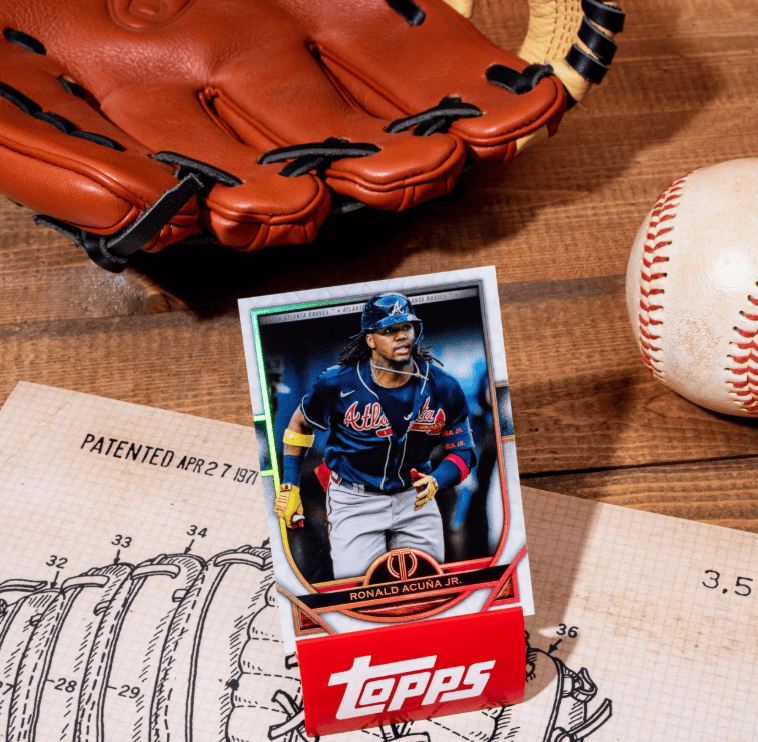
Custom vs. Traditional Trading Cards: Key Differences
Custom Trading Cards vs. Traditional Trading Cards: What’s the Difference?
Trading cards have been part of sports culture for generations. From vintage baseball cards and iconic rookie cards to modern holographic parallels and limited-edition collectibles, they have given fans a way to celebrate their favorite athletes and unforgettable moments.
But the world of trading cards is changing.
Today, collectors, athletes, parents, coaches, schools, and sports organizations have another option: custom trading cards.
Instead of collecting only professional athletes featured in traditional trading card releases, individuals can create personalized cards featuring themselves, their children, their teammates, or someone whose accomplishments deserve recognition.
So what is the difference between custom trading cards and traditional trading cards? Are custom sports cards made with the same level of quality? And which option offers the better collecting experience?
This complete guide explains how custom and traditional trading cards compare in design, printing quality, personalization, rarity, cost, collectible value, and overall purpose.
What Is the Difference Between Custom Trading Cards and Traditional Trading Cards?
The primary difference between custom trading cards and traditional trading cards is who controls the design and who appears on the card. Traditional trading cards are typically mass-produced or commercially released collectibles featuring athletes, characters, or subjects selected by established manufacturers. Custom trading cards are personalized collectibles created for a specific person, team, event, or organization.
Traditional sports cards typically feature professional athletes and are distributed through packs, boxes, sets, or individual releases.
Custom sports cards allow individuals and organizations to choose the subject, photographs, personal information, and design elements, depending on the card provider.
Both can feature professional printing, premium card stock, holographic finishes, and collectible designs. However, their purposes and secondary markets often differ.
Quick Comparison: Custom vs. Traditional Trading Cards
| Feature | Traditional Trading Cards | Custom Trading Cards |
|---|---|---|
| Featured athletes | Primarily selected by manufacturers | Selected by the customer |
| Personalization | Usually predetermined | Often highly customizable |
| Card design | Manufacturer-controlled | Customer-selected or custom-designed |
| Player photos | Professionally licensed or supplied | Uploaded or provided by customers |
| Player information | Published athlete statistics and details | Personalized names, numbers, teams, and information |
| Production | Commercial product releases | Usually made to order or commissioned |
| Premium finishes | Available on selected products | Available from participating custom manufacturers |
| Serial numbering | Available on selected cards | Possible with providers offering numbered editions |
| Collector resale market | Established for many products | Generally smaller and less established |
| Best suited for | Hobby collecting, trading, and set building | Personal keepsakes, recognition, gifts, and group collections |
Neither category is automatically better.
The right choice depends on whether the goal is collecting established sports memorabilia or creating a collectible that celebrates someone personally meaningful.
What Are Traditional Trading Cards?
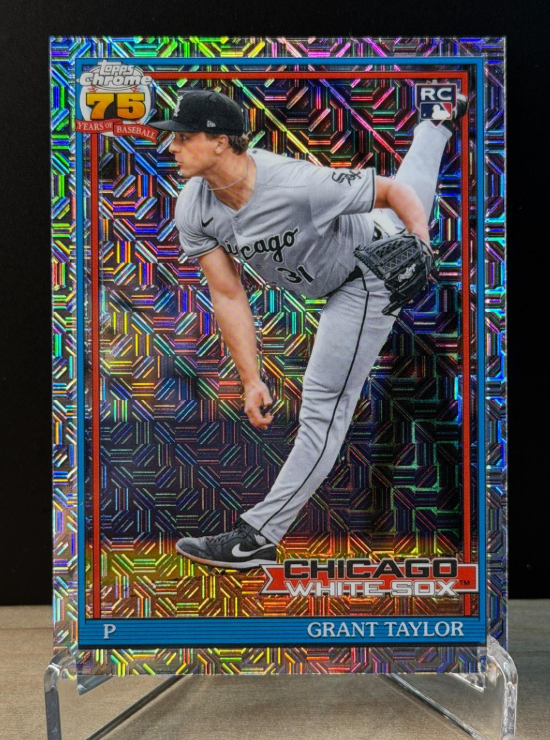
Traditional trading cards are commercially produced collectible cards featuring athletes, teams, entertainment characters, or other subjects.
Within the sports card hobby, manufacturers such as Topps, Panini, and Upper Deck are associated with well-known trading card products and collecting traditions.
Traditional sports cards may include baseball, football, basketball, soccer, hockey, and other sports.
Collectors can purchase cards through sealed packs, hobby boxes, retail products, special releases, and secondary marketplaces.
What Makes Traditional Sports Cards Collectible?
Traditional trading cards appeal to collectors for several reasons.
Recognized athletes and teams: Cards often feature professional athletes with established fan bases.
Established product lines: Familiar brands and sets provide collectors with recognizable products.
Rookie cards: Many collectors pursue cards associated with an athlete’s early professional career.
Limited editions and parallels: Special variations may feature different colors, finishes, and production quantities.
Autographs and memorabilia: Certain releases include signatures or memorabilia-related features.
Secondary-market activity: Many traditional sports cards can be researched through public sales records, auction results, and grading databases.
The combination of sports history, established collecting traditions, recognizable brands, and market demand has helped traditional trading cards develop a substantial global hobby community.
What Are Base Cards, Parallels, and Inserts?
Traditional trading card products often contain several categories of cards.
Base cards form the primary checklist of a release.
Parallel cards are variations of base or other cards, often featuring different colors, foil treatments, or numbering.
Insert cards belong to additional subsets that may feature unique designs or themes.
Some releases also include autographed cards, memorabilia cards, and serial numbered editions.
These variations create different collecting opportunities, from completing a base set to chasing rare cards of a favorite athlete.
What Are Custom Trading Cards?
Custom trading cards are personalized collectible cards created using a customer’s selected photographs, names, player information, designs, or other details.
Unlike traditional sports cards, custom trading cards do not require the featured athlete to be a professional player or part of an established manufacturer’s checklist.
A youth baseball player, high school football athlete, recreational soccer player, basketball team, or adult sports league participant can be featured on a custom card.
Personalized trading cards can also celebrate coaches, teachers, graduates, employees, family members, performers, and other individuals.
What Information Can You Put on a Custom Trading Card?
Depending on the manufacturer and available customization tools, a personalized trading card may include:
- Athlete’s name and photograph
- Team or league name
- Jersey number and position
- Team colors and approved logos
- Player biography or achievements
- Personalized messages
- Statistics or performance highlights
- Holographic or foil design options
- Rookie-style graphics or special-edition elements
- QR codes or additional information
The defining characteristic is that the customer has input into the card’s content.
For youth athletes in particular, this creates an opportunity to enjoy a trading card experience that traditionally has been associated with professional sports.
Can Custom Trading Cards Look Like Professional Sports Cards?
Yes. Professionally manufactured custom trading cards can offer premium printing, detailed artwork, standard trading card dimensions, holographic finishes, and protective display options similar to features found throughout the traditional sports card hobby.
However, quality varies significantly among providers.
There is a substantial difference between printing a card on ordinary paper at home and ordering a professionally manufactured custom trading card.
What Makes a Custom Trading Card Professional Quality?
Several factors influence the final product.
Card stock and construction
The thickness, rigidity, coating, and material quality affect how a card looks and feels.
Printing resolution
High-quality printing helps preserve image detail, accurate colors, readable text, and clean graphics.
Cutting and finishing
Accurate trimming, consistent dimensions, and clean edges contribute to a professional appearance.
Holographic and reflective finishes
Certain custom card providers offer premium finishes that create the visual effects familiar to collectors.
Design quality
Typography, image placement, borders, player details, and overall composition influence whether a custom card feels like an authentic collectible.
Protective presentation
Acrylic slabs, protective cases, and other display accessories can improve how cards are presented, stored, and showcased.
Are Custom Trading Cards the Same Size as Traditional Sports Cards?
Many modern sports trading cards use the standard dimensions of 2.5 inches wide by 3.5 inches tall.
Professional custom trading card manufacturers can produce cards in this familiar size.
However, not every traditional or custom trading card uses these dimensions. Some manufacturers offer oversized cards, mini cards, unusually thick cards, and alternative formats.
Collectors should confirm card measurements before selecting protective sleeves or cases.
Are Custom Trading Cards as Valuable as Traditional Trading Cards?
Custom trading cards and traditional trading cards can both be valuable, but not necessarily in the same way.
Traditional sports cards often have established collector markets influenced by athlete popularity, rookie status, product reputation, condition, scarcity, and historical sales.
Custom trading cards typically emphasize personal, sentimental, commemorative, or community value.
Traditional Trading Cards and Market Value
A professionally licensed rookie card featuring a popular athlete may attract collectors across the country or around the world.
Its potential resale value can be influenced by:
- Player popularity and career achievements
- Card rarity and print run
- Manufacturer and product recognition
- Professional grading
- Autographs and special variations
- Card condition
- Supply and demand
- Comparable secondary-market sales
These established market factors give collectors a way to evaluate many traditional cards.
Nevertheless, not every traditional sports card is valuable. Many common cards have modest resale value.
Custom Trading Cards and Personal Value
A personalized card featuring a child’s first baseball season may have little established resale market, yet hold considerable value to the child’s family.
A commemorative card celebrating a championship-winning soccer team could become a treasured keepsake.
A personalized trading card honoring a retiring coach might carry an emotional significance that cannot easily be measured by auction prices.
The key distinction is that traditional trading cards often derive value from established collector demand, while custom trading cards frequently derive value from personal meaning and the story they preserve.
This does not mean custom cards can never become collectible or desirable in their own right.
Limited custom releases, signed editions, recognized creators, and special events can sometimes attract collector interest. However, such interest should not be confused with guaranteed resale value.
Why Are Custom Trading Cards Becoming Popular?
Custom trading cards offer an appealing combination of personalization, sports culture, and commemorative recognition.
Families can celebrate young athletes. Teams can create coordinated player collections. Schools can recognize students. Organizations can develop branded keepsakes.
Several features make personalized trading cards particularly attractive.
1. Anyone Can Be Featured on a Trading Card
Traditional sports cards generally feature subjects chosen by the manufacturer.
Custom trading cards allow customers to choose someone meaningful to them.
A child playing their first season of soccer can have a card.
A high school senior competing in their final football season can have a card.
An adult softball player can have a card.
For many people, the opportunity to see themselves represented on a professional-looking collectible is the most exciting part of the experience.
2. Every Card Can Tell a Personal Story
A traditional sports card generally presents information chosen for a commercial release.
A custom card offers greater flexibility.
A player might choose their favorite action photo, jersey number, team colors, and personal achievements.
A team could celebrate its championship season.
A family could create cards commemorating an athlete’s progression from recreational sports to varsity competition.
Rather than representing a moment selected by a major card manufacturer, custom trading cards can celebrate moments chosen by the people who experienced them.
3. Custom Trading Cards Make Unique Gifts
Personalized sports cards can be meaningful gifts for birthdays, holidays, senior nights, graduation ceremonies, end-of-season celebrations, and other milestones.
Unlike a traditional card purchased from a retailer, a custom card can feature the recipient or someone important to them.
4. Teams and Leagues Can Create Their Own Collections
Custom trading cards are not limited to individual orders.
Youth sports teams, recreational leagues, schools, clubs, and other organizations can create coordinated collections featuring multiple participants.
This allows players and families to collect teammates, trade cards, and preserve memories of the season.
5. Custom Cards Bring the Collector Experience to New Audiences
Many athletes dream of appearing on a trading card.
For most youth and amateur athletes, that opportunity is unlikely to come through a traditional professional sports card release.
Custom cards make a similar type of experience accessible beyond the professional sports world.
Custom Trading Cards vs. Traditional Trading Cards for Youth Sports
One of the most meaningful differences between traditional and custom cards appears in youth sports.
Traditional sports cards allow young athletes to collect their professional heroes.
Custom sports cards allow young athletes to celebrate their own participation.
Traditional Cards: Collecting Your Heroes
A young baseball player may collect cards of their favorite Major League Baseball stars.
A basketball player might build a collection featuring professional athletes they admire.
These cards create connections between fans and the broader world of sports.
Custom Cards: Becoming the Athlete on the Card
Imagine that same baseball player receiving a professionally printed card featuring their own name, team uniform, jersey number, and favorite action photograph.
Instead of collecting only professional athletes, the child becomes the featured athlete.
For parents and families, personalized trading cards can preserve moments that might otherwise live only in photographs.
For coaches and leagues, they can become a way to recognize every player’s participation.
Traditional trading cards celebrate the athletes we admire. Custom trading cards can celebrate the athletes in our own lives.
Both experiences have a meaningful place in sports collecting.
Are Custom Trading Cards Good for Teams, Leagues, and Schools?
Yes. Custom trading cards can serve as personalized keepsakes, team memorabilia, player recognition items, fundraising products, and promotional collectibles.
They are particularly relevant for organizations that want to create something memorable for a group.
Youth Sports Teams
Custom player cards can be created for baseball, softball, soccer, football, basketball, hockey, lacrosse, wrestling, and other sports.
A coordinated collection can feature each participant in the same team design.
Sports Leagues
Larger leagues can create collections representing multiple teams, age groups, or divisions.
This can help participants feel connected to the larger organization while preserving individual player recognition.
Schools and Athletic Programs
Schools can use personalized trading cards to recognize student athletes, celebrate senior seasons, commemorate championships, and highlight special achievements.
Tournaments and Events
A tournament trading card collection can commemorate participating athletes, championship teams, or notable performances.
Fundraising Programs
Some organizations use custom collectibles as part of fundraising campaigns.
For example, a youth sports league could organize a personalized card program with a fundraising contribution built into the approved pricing structure.
Such programs require a clear plan for pricing, permissions, production, distribution, and proceeds.
Corporate and Community Organizations
Custom trading cards can also be used for employee recognition, team-building activities, promotional events, branded campaigns, and special celebrations.
The format’s flexibility extends far beyond traditional sports collecting.
Can Custom Trading Cards Have Holographic Finishes and Limited Editions?
Yes. Depending on the manufacturer, custom trading cards may incorporate premium holographic finishes, metallic effects, alternate designs, and limited-edition numbering.
These features are inspired by elements collectors recognize from traditional trading cards.
Holographic Custom Trading Cards
Holographic card finishes can create reflective visual effects that change as the card moves under light.
Some providers offer rainbow or patterned holographic finishes that add visual depth and collector appeal.
A personalized card with these finishes can feel substantially different from a basic printed photo card.
Limited-Edition Custom Trading Cards
A custom trading card project can be designed around a particular production quantity.
For example, an organization might commission a limited run of 100 commemorative cards.
If the manufacturer supports individually numbered production, the cards could be marked with serial numbers such as 001/100 through 100/100.
However, numbering does not automatically establish authenticity, exclusivity, or investment value. A trustworthy limited-edition release should accurately disclose and honor the stated production quantity.
Can Custom Trading Cards Be One of One?
Yes, a custom card can be produced as a one-of-one edition when only one copy is made for that defined version.
It is important to distinguish a genuinely exclusive one-of-one production run from a card that simply features a unique name or photograph.
A personalized card may be unique in design without having an independently verifiable limited-edition program.
For collectors, clear communication about production quantities helps preserve trust.
Can Custom Trading Cards Be Professionally Graded?
Some custom trading cards may be eligible for professional grading or encapsulation, depending on the policies of the grading company and the characteristics of the card.
Eligibility is not guaranteed.
Major grading companies have different requirements for identifying, authenticating, and accepting custom-made or independently produced cards.
Collectors interested in grading a custom card should verify the company’s current eligibility rules before submitting it.
It is also important to understand that protective acrylic display cases are not the same as authenticated, professionally graded slabs.
A custom display slab can protect and showcase a card, but it does not by itself establish professional authentication or a numerical condition grade.
Are Custom Trading Cards Officially Licensed?
Not necessarily.
Traditional trading cards from licensed product lines may incorporate authorized league, team, and player rights.
Custom trading cards are not automatically officially licensed simply because they feature a sports theme or professional-quality design.
Customers and organizations should ensure they have appropriate permissions to use copyrighted photographs, protected logos, team marks, and other intellectual property.
A custom card featuring a youth athlete wearing their own team uniform is different from a manufacturer claiming official licensing from a major professional league.
Professional printing quality and official sports licensing are separate things.
This distinction is important for collectors and anyone commissioning custom trading cards.
What Is the Difference Between Homemade and Professionally Printed Custom Trading Cards?
Not all custom trading cards are manufactured the same way.
Some people create cards at home using a printer, paper, and basic design software.
Others use professional custom trading card companies that specialize in printing, finishing, and collectible presentation.
| Feature | Homemade Custom Cards | Professionally Manufactured Custom Cards |
|---|---|---|
| Printing | Consumer or home printer | Professional printing equipment |
| Card stock | Depends on materials available | Specified card materials |
| Cutting | Often cut manually | Production cutting and finishing |
| Holographic effects | Limited without specialty tools | Available from select providers |
| Design | Customer-created | Templates or professional design options |
| Consistency | Depends on individual technique | Typically more standardized |
| Production quantities | Usually small batches | Individual or group orders |
| Presentation | Basic sleeves or homemade packaging | Optional premium protective accessories |
Homemade cards can be creative and meaningful.
Professional manufacturing is often preferable when consistency, premium visual effects, and polished presentation are priorities.
Introducing NCASE CARDS: Professional Custom Trading Cards for Every Athlete
At NCASE CARDS, we believe the excitement of owning a professional-quality trading card should not be limited to professional athletes.
Our mission is to give athletes, families, teams, leagues, and organizations the opportunity to create their own personalized collectibles.
NCASE CARDS specializes in custom sports trading cards featuring professional printing, personalized designs, and premium collectible presentation.
Personalized Sports Cards
Customers can create cards featuring their own photographs, names, jersey numbers, team information, and other personalized details.
From youth baseball and football to basketball, soccer, hockey, and more, NCASE CARDS brings personalized card creation to a wide range of sports.
Premium Holographic Trading Cards
Our premium holographic cards offer a collectible appearance inspired by the reflective finishes popular throughout the sports card hobby.
NCASE Core Edition
For customers seeking premium presentation, the NCASE Core Edition combines a personalized holographic trading card with a customized acrylic slab and protective bumper frame.
The acrylic slab provides a distinctive way to present and showcase a player’s card.
Custom Trading Cards for Teams and Leagues
NCASE CARDS also supports group ordering for sports teams and leagues.
Our online team ordering system is designed to simplify personalized card creation for larger groups.
A coach or league administrator can create a team or league, share a dedicated ordering link, and allow participating families to personalize individual player cards.
Eligible group orders can then be coordinated for shipment to the designated team or league contact.
This approach makes it easier to offer personalized trading cards across entire rosters without requiring every card to be individually designed by the coach.
Celebrating More Than Professional Sports
A trading card can represent far more than professional statistics or national recognition.
It can celebrate the first goal of a season, the last game of a senior year, a championship victory, or a young athlete’s love of the game.
Explore NCASE CARDS to discover professional-quality custom trading cards for individual athletes, teams, and leagues.
Which Is Better: Custom Trading Cards or Traditional Trading Cards?
The answer depends on what you want to collect and why.
Choose traditional trading cards if:
- You enjoy collecting professional athletes or established trading card sets.
- You want to open packs and chase rare cards.
- You are interested in rookie cards, autographs, parallels, or established hobby brands.
- You value access to a more developed secondary resale market.
Choose custom trading cards if:
- You want a trading card featuring yourself, your child, or someone you know.
- You want to personalize photographs, names, teams, and design elements.
- You are creating gifts, keepsakes, or special event memorabilia.
- You want coordinated cards for a team, league, school, or organization.
- You want to celebrate a personal achievement or meaningful moment.
There is no requirement to choose only one.
A collector can enjoy traditional baseball cards featuring professional stars while also preserving their child’s baseball season through a personalized card.
In fact, these two types of collectibles often complement one another.
Frequently Asked Questions About Custom vs. Traditional Trading Cards
What is the difference between custom and traditional trading cards?
Traditional trading cards are commercially released collectibles featuring subjects selected by manufacturers. Custom trading cards are personalized collectibles featuring photographs, names, designs, and information selected by customers. Traditional cards often serve established collector markets, while custom cards frequently focus on personal memories, gifts, and recognition.
Are custom trading cards real trading cards?
Yes. Custom trading cards are physical collectibles that can use traditional card sizes, professional printing, and premium finishes. However, they are not automatically official, licensed, or manufacturer-issued cards from an established trading card product line.
Can custom trading cards look like Topps or Panini cards?
Professional custom trading cards can offer comparable general characteristics such as standard dimensions, detailed printing, holographic finishes, and collectible presentation. However, custom designs should respect protected manufacturer artwork, trademarks, and other intellectual property.
Are custom trading cards worth collecting?
Yes. Custom trading cards can hold significant personal or commemorative value, especially when celebrating athletes, teams, family milestones, or special events. Their secondary-market value is generally less established than that of traditional sports cards.
Are custom trading cards worth money?
Some custom cards may attract resale interest, but many are purchased primarily as personal keepsakes rather than investments. Value depends on factors such as demand, creator recognition, authenticity, scarcity, and significance.
Can you create your own baseball trading card?
Yes. Custom baseball trading cards can feature a player’s photo, name, jersey number, position, team details, and other personalized information. Professional custom card companies can produce these as physical collectibles.
Can kids have their own sports trading cards?
Yes. Youth athletes can have personalized sports trading cards created using their own photos and player information. These are commonly used as keepsakes, gifts, team collectibles, and end-of-season awards.
Can you make custom trading cards for an entire sports team?
Yes. Custom team trading cards can be produced with consistent team designs and personalized player information. Some providers offer group ordering systems that allow families to submit their own information and photographs.
Do custom trading cards come in holographic finishes?
Some custom trading card manufacturers offer holographic or reflective finishes. Available effects vary by provider, product, and production method.
Are custom trading cards the same size as regular sports cards?
Many custom sports cards use the standard 2.5 by 3.5-inch trading card format, although sizes vary. This is also a common size for modern traditional sports cards.
Can you make custom rookie cards?
Yes. Custom trading cards can feature rookie-style artwork and designs celebrating a player’s first season. However, these should not be misrepresented as officially recognized rookie cards issued by a major trading card manufacturer.
Can custom trading cards have serial numbers?
Yes. Certain custom production projects can incorporate individually numbered limited editions. Customers should verify that the provider supports accurate production tracking and that any stated edition limit is genuine.
Can custom trading cards be professionally graded?
Some custom cards may qualify for grading or authentication, depending on the grading company’s acceptance policies. Eligibility must be verified with the grading company.
Are custom trading cards good gifts for athletes?
Yes. Personalized trading cards can commemorate birthdays, senior nights, championship seasons, graduations, and individual achievements. They are especially meaningful because the featured athlete is someone personally connected to the recipient.
Can custom trading cards be used for school fundraisers?
Yes. Schools and athletic organizations can incorporate personalized trading cards into fundraising programs. The organization should establish pricing, ordering procedures, permissions, and fundraising arrangements before launching the campaign.
Where can I order professional-quality custom trading cards?
Professional custom trading cards can be ordered from specialized manufacturers such as NCASE CARDS at www.ncasecards.com. NCASE offers personalized sports cards, premium holographic options, acrylic slab presentation, and ordering solutions for teams and leagues.
Final Thoughts: Two Ways to Celebrate the Game
Traditional trading cards and custom trading cards share something important: both celebrate the people and moments that make sports meaningful.
Traditional cards connect fans with professional athletes, historic achievements, famous teams, and the excitement of the collecting hobby.
Custom cards bring that experience closer to home.
They give athletes of all ages the opportunity to see themselves represented on a professional-quality collectible.
For a lifelong collector, a rare rookie card may be a prized possession.
For a parent, a personalized trading card featuring their child’s first season might be just as meaningful.
Both deserve a place in the world of sports collectibles.
At NCASE CARDS, we believe every athlete has a story worth collecting.
Your Game. Your Story. Your Card.
NCASE the Moment.
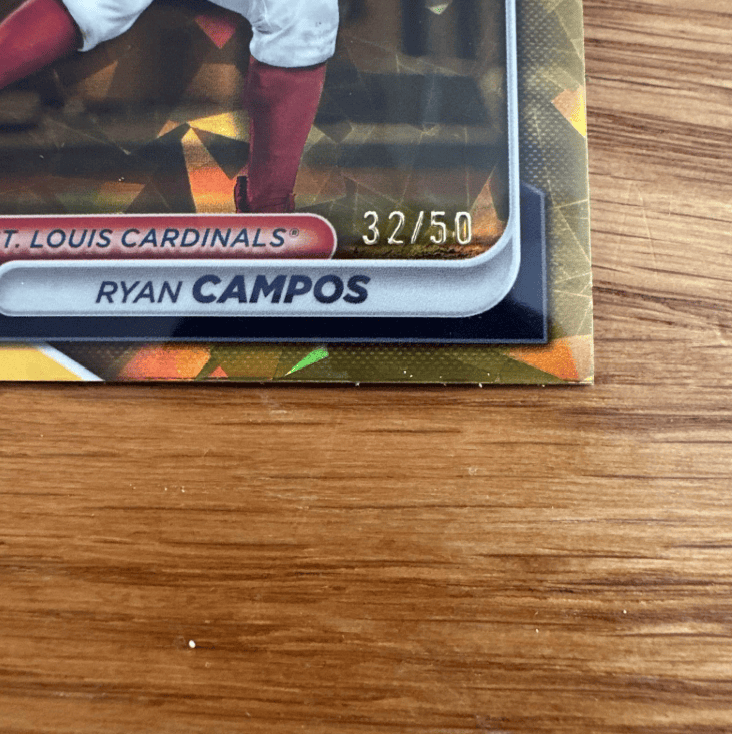
What are Serial Numbered Trading Cards?
What Are Serial Numbered Trading Cards? A Complete Collector’s Guide to Numbered Sports Cards
If you’ve ever opened a pack of sports cards and discovered a card stamped 12/99, 5/25, or 1/1, you may have pulled something special.
Serial numbered trading cards are among the most exciting collectibles in the sports card hobby. From baseball and football to basketball, soccer, hockey, and other trading card categories, these limited-production cards introduce an entirely different level of rarity, exclusivity, and collecting excitement.
But what exactly does serial numbering mean? Does a lower number make a card more valuable? And why are collectors willing to pay a premium for certain numbered parallels?
Whether you’re opening your first hobby box, collecting your favorite athlete, or learning how sports card rarity works, this guide explains everything you need to know about serial numbered trading cards.
What Are Serial Numbered Trading Cards?
Serial numbered trading cards are limited-production collectible cards individually marked with a number identifying a particular copy within a defined print run. The numbering typically appears as a fraction, such as 25/99, indicating that the card is copy number 25 from a limited edition of 99.
The first number identifies the individual copy. The second number identifies the total number of copies in that particular numbered edition.
For example, a baseball card stamped 07/25 is one of only 25 cards produced in that specific numbered version.
Unlike common base trading cards, which may be produced in large quantities, serial numbered sports cards have a stated production limit for the particular version. This gives collectors a clearer understanding of the card’s scarcity.
Serial numbering is commonly used by trading card companies like Topps, Panini, Leaf and Upper Deck on special parallels, autographed cards, premium inserts, and limited-edition releases.
Quick Answer: What Does Serial Numbered Mean on a Trading Card?
A serial numbered trading card is an individually numbered card from a limited print run. A card marked 10/50 identifies copy number 10 from an edition of 50. A card marked 1/1 is a one-of-one, meaning only one copy of that exact numbered version exists.
How Do Serial Numbers Work on Sports Cards?
Serial numbering creates an identifiable production limit for a particular trading card edition.
Manufacturers typically place the number on the front or back of the card using foil stamping, printing, or another production technique.
Common serial numbering formats include:
| Serial Number | Meaning |
|---|---|
| 125/499 | Copy 125 of 499 |
| 075/199 | Copy 75 of 199 |
| 023/099 | Copy 23 of 99 |
| 018/050 | Copy 18 of 50 |
| 007/025 | Copy 7 of 25 |
| 003/010 | Copy 3 of 10 |
| 002/005 | Copy 2 of 5 |
| 1/1 | One-of-one edition |
A card stamped 25/99 and another stamped 75/99 have the same stated edition size. Both belong to a print run of 99.
The first number distinguishes the copies, but it does not change their overall edition rarity.
Important: A card marked 01/99 is not inherently rarer than a card marked 75/99. Both are one of 99 copies. However, certain copy numbers can be more desirable to collectors.
Why Are Serial Numbered Trading Cards Special?
The biggest appeal of serial numbered trading cards is their combination of documented scarcity, visual distinction, and personal collecting significance.
1. Limited Production Creates Scarcity
A traditional base card may have a much larger production run than its numbered parallel.
A parallel limited to 25 copies gives collectors a clear understanding of how many cards exist in that particular edition.
This production limit makes numbered parallels appealing to collectors who want something less widely available.
2. Every Card Has Its Own Individual Number
Serial numbering allows a collector to identify an exact copy within an edition.
Imagine two collectors owning the same basketball player’s Gold parallel numbered to 50.
One owns 08/50. The other owns 39/50.
Both cards belong to the same limited edition, but each has its own unique serial number.
That distinction makes the individual card feel more personal.
3. Special Finishes Add Collector Appeal
Many numbered trading cards feature visual enhancements such as:
- Gold, red, blue, green, or other colored parallels
- Holographic and rainbow foil finishes
- Refractor-style reflective surfaces
- Cracked ice or patterned foil
- Special autograph variations
- Premium card stock and limited-edition designs
These features can make a numbered card visually different from its standard base version.
4. Numbered Cards Create the Thrill of the Chase
One of the most exciting experiences in collecting is discovering an unexpected rare card inside a pack.
Opening a card numbered to 99 is exciting. Pulling a card numbered to 10 can feel even more significant.
Finding a 1/1 card can be a defining moment in a collector’s hobby experience.
Serial numbered cards help create that sense of discovery.
What Is the Difference Between Serial Numbered Cards and Parallel Cards?
A parallel trading card is an alternate version of an existing card, while a serial numbered card is a card with a stated, individually numbered print run.
These concepts overlap, but they are not identical.
A parallel may feature a different border color, holographic treatment, foil pattern, or other visual variation.
Some parallels are serial numbered. Others are not.
For example, a collector might encounter a standard baseball base card, an unnumbered rainbow parallel, a Gold parallel numbered to 50, and a Red parallel numbered to 5.
The Gold and Red versions are both parallels and serial numbered cards.
The unnumbered rainbow card is a parallel but does not have an individually stamped edition number.
Additionally, serial numbering is not limited to parallels. Autographed cards and special inserts may also receive individual numbering.
Serial Numbered Cards vs. Base Cards vs. Inserts
| Card Type | Main Characteristic | Always Numbered? |
|---|---|---|
| Base card | Standard card in a release | No |
| Parallel card | Alternate variation of a card | No |
| Insert card | Card from a distinct subset or design | No |
| Autograph card | Features a player or celebrity signature | No |
| Serial numbered card | Individually numbered limited edition | Yes |
| One-of-one card | Unique version with only one copy | Typically marked 1/1 |
Understanding these differences helps collectors identify the cards they own and research their potential value.
What Does 1/1 Mean on a Trading Card?
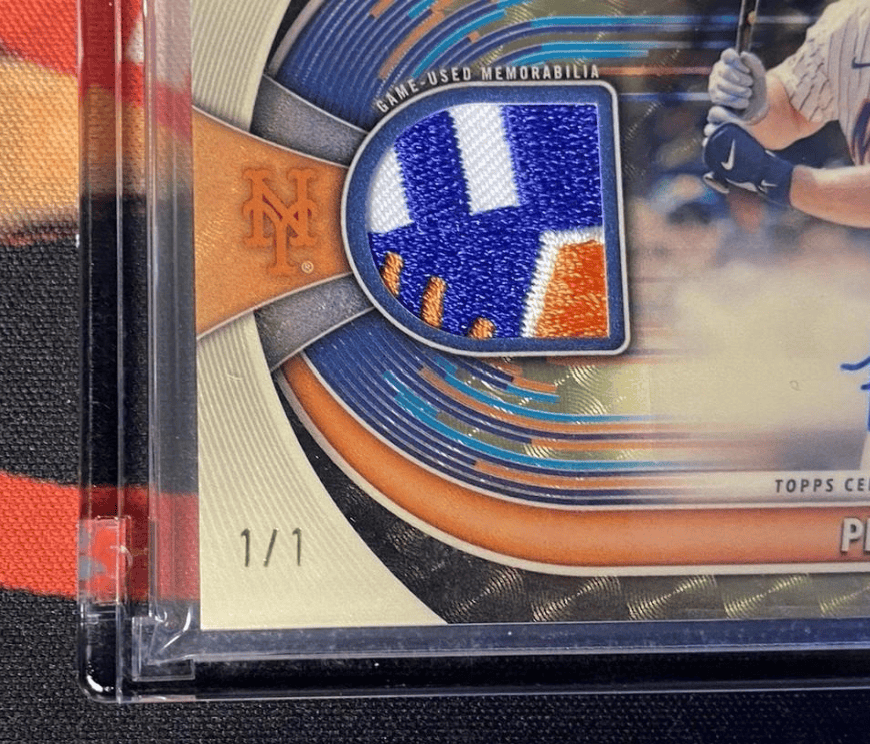
A 1/1 trading card.A 1/1 trading card, pronounced “one of one,” is a card produced as the only copy of that exact edition or variation.
One-of-one cards represent the smallest possible print run for a particular numbered version.
They can include specially designed parallels, premium autograph cards, printing plates, and other exclusive collectibles.
However, an important distinction exists.
A one-of-one does not necessarily mean it is the only trading card ever produced featuring that athlete.
A single athlete may appear in multiple sets, with several different 1/1 cards across different products and variations.
The 1/1 designation applies to that specific edition.
Are 1/1 Trading Cards Valuable?
Some one-of-one cards can command significant prices, especially when they feature popular athletes, highly desirable rookie cards, premium releases, or historically important collectibles.
However, being a 1/1 does not automatically make a card expensive.
A one-of-one card featuring a relatively unknown athlete may attract less demand than a numbered rookie card of a superstar.
Scarcity is only one component of collectible value.
Are Lower Numbered Trading Cards Worth More?
Lower print runs often contribute to higher collector interest, but a smaller edition size does not guarantee a higher selling price.
For example, a desirable rookie card numbered to 10 may command a premium over the same player’s comparable parallel numbered to 99.
However, several other factors influence card values.
What Determines the Value of a Serial Numbered Sports Card?
Player popularity: Cards featuring established stars, promising rookies, and historically significant athletes often attract stronger collector interest.
Rookie status: Numbered rookie cards can be especially attractive because they represent an athlete’s early professional collecting history.
Print run: A card numbered to 5 is scarcer within its particular edition than a comparable card numbered to 100.
Brand and product: Different trading card products have different levels of collector demand, brand recognition, and prestige.
Card condition: Surface quality, centering, edges, and corners can meaningfully affect value.
Professional grading: Grades from established authentication and grading companies may influence collector confidence and resale prices.
Design and rarity tier: Certain parallels have stronger collector followings because of their appearance, tradition, or place within a particular product.
Market demand: Recent comparable sales and buyer interest ultimately influence what collectors are willing to pay.
A useful rule for collectors is:
Scarcity determines how many copies exist. Demand helps determine what buyers will pay.
What Are Jersey Numbered Trading Cards?
A jersey numbered trading card is a serial numbered card whose individual copy number matches the athlete’s uniform number.
For example, suppose a basketball player wears jersey number 23.
A numbered parallel stamped 23/99 would be considered a jersey-number match.
Collectors sometimes call these jersey-number matches or jersey-matched cards.
Because the serial number connects directly to the featured athlete’s identity, certain collectors are willing to pay more for these specific copies.
However, the premium varies by player, product, and collector demand.
Are First and Last Serial Numbers More Valuable?
Some collectors seek specific positions within a numbered edition.
Examples include:
- First off the line: The first numbered copy, such as 01/99. This should not be confused with manufacturer products formally labeled First Off The Line, or FOTL.
- Last numbered copy: The final copy in an edition, such as 99/99.
- Jersey-number match: A copy numbered to match an athlete’s uniform number, such as 23/99.
- Memorable serial numbers: Numbers with personal or cultural significance.
These preferences can create additional demand, but they do not change the actual number of cards produced in the edition.
How Rare Are Serial Numbered Trading Cards?
The rarity of a serial numbered trading card depends on the edition size, the total number of other variations produced, and how the card was distributed.
A card numbered to 499 is more widely produced than an otherwise comparable version numbered to 25.
However, rarity should be evaluated within the context of the entire product.
Consider a hypothetical athlete whose card is released in several versions:
| Card Variation | Example Print Run |
|---|---|
| Standard base card | Not individually numbered |
| Blue parallel | /199 |
| Green parallel | /99 |
| Gold parallel | /50 |
| Orange parallel | /25 |
| Black parallel | /10 |
| Red parallel | /5 |
| Platinum parallel | 1/1 |
Illustrative example only. Actual parallel colors and edition sizes vary by manufacturer and product.
This creates multiple levels of scarcity within a single card design.
Collectors who attempt to acquire every available parallel of a particular player often refer to this pursuit as building the rainbow.
What Is a Trading Card Rainbow?
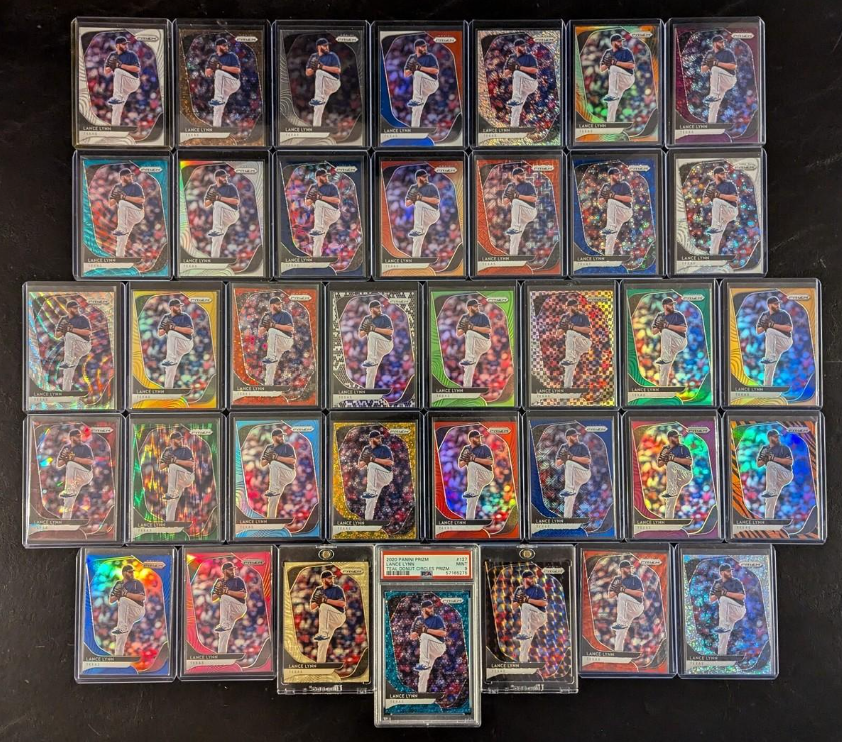
The Rainbow Universe
A trading card rainbow is a collection of the different parallel variations of the same card.
A collector might seek the base card, every available color variation, and each numbered edition, sometimes including the one-of-one.
Completing a rainbow can be challenging, particularly when the collection includes extremely limited parallels.
For player collectors, rainbow collecting can turn a single favorite athlete’s card into a long-term collecting project.
How Can You Tell If a Trading Card Is Serial Numbered?
The easiest way to identify a serial numbered trading card is to examine its front and back for a fraction-style number.
Look for markings such as 15/99, 04/25, or 1/1.
These markings are commonly found near the bottom edge, in a corner, beside an autograph area, or on the back of the card.
How to Identify a Numbered Sports Card
Step 1: Examine both sides. Look for a clearly printed or stamped fraction that identifies an individual copy and total edition size.
Step 2: Identify the manufacturer and set. Determine the product name, release year, player, and card number.
Step 3: Compare the parallel design. Look for unusual foil patterns, border colors, background treatments, or special finishes.
Step 4: Review the official checklist. Compare the card against manufacturer information to confirm its exact parallel and announced numbering.
Step 5: Research comparable cards. Review verified examples and recent sales to better understand the card’s relative scarcity and market demand.
Remember that the regular checklist number printed on the back of a baseball or football card is not the same as an individual serial number.
A card labeled #125 in a set may simply be card number 125 on the checklist.
A card stamped 25/99 identifies an individual copy from a numbered edition of 99.
Do Holographic Trading Cards Have Serial Numbers?
Some holographic trading cards are serial numbered, but many are not.
A holographic finish describes a card’s visual appearance, while serial numbering describes an edition’s individual numbering and production limit.
A card can be holographic without being serial numbered.
Likewise, a serial numbered card can have a traditional non-holographic finish.
For collectors, the combination of premium holographic effects and limited-edition numbering can create an especially appealing collectible.
This is one reason colorful numbered parallels remain a recognizable feature of modern sports card collecting.
Are Serial Numbered Trading Cards Good Collectibles?
Serial numbered cards can be excellent additions to a collection, particularly for collectors who enjoy limited editions, specific athletes, parallel sets, and documented scarcity.
They offer several advantages.
Identifiable edition size: Collectors can see the stated quantity of a particular version.
Personal significance: Individual copy numbers can connect to favorite jersey numbers, dates, or milestones.
Collecting challenges: Numbered parallels give collectors different rarity levels to pursue.
Visual variety: Premium finishes and alternate colors create additional collecting options.
Potential resale appeal: Certain scarce cards attract strong secondary-market interest.
That said, collectible cards should not automatically be treated as financial investments.
Values can fluctuate based on player performance, popularity, market cycles, condition, and other factors.
Collecting something meaningful to you is often the most rewarding place to start.
Can You Create Custom Serial Numbered Trading Cards?
Custom trading cards offer a way to bring limited-edition collecting concepts beyond traditional professional sports card releases.
For example, a youth baseball team might create a special commemorative card celebrating a championship season.
A soccer league could develop a collector series highlighting standout performances.
A professional athlete could launch a limited-edition card release with multiple design variations.
Custom trading card projects may incorporate concepts such as numbered editions, special finishes, exclusive artwork, and limited release quantities, depending on the production options available.
Bringing the Collector Experience to Your Own Cards
At NCASE CARDS, we believe the excitement of collecting should not be limited to professional athletes.
Our custom trading cards allow athletes, teams, leagues, schools, and organizations to turn meaningful moments into professional-quality collectibles.
From personalized player cards to premium holographic designs and special collectible projects, NCASE CARDS helps bring the look and excitement of the trading card hobby to athletes at every level.
Whether you’re celebrating a championship, recognizing an individual athlete, or developing a custom collectible release, the inspiration behind limited-edition trading cards opens up exciting creative possibilities.
Explore NCASE CARDS and discover how you can turn your favorite moment into a custom trading card.
Frequently Asked Questions About Serial Numbered Trading Cards
What is a serial numbered trading card?
A serial numbered trading card is a limited-edition card marked with an individual copy number and a total print run. For example, 15/99 means the card is copy 15 from a numbered edition of 99.
What does /99 mean on a sports card?
A sports card numbered to 99 belongs to an edition limited to 99 individually numbered copies. A marking such as 25/99 identifies the specific copy within that edition.
What does /25 mean on a trading card?
A card stamped 07/25 is copy number seven from a limited edition of 25. The denominator indicates the stated print run of that particular version.
What does 1/1 mean on a sports card?
A 1/1 sports card is a one-of-one collectible. It is the only copy produced in that exact numbered variation, although other cards featuring the same athlete may exist.
Are serial numbered trading cards rare?
Serial numbered trading cards have defined edition sizes, making their relative scarcity easier to identify. A card numbered to 5 is rarer within its edition than a comparable card numbered to 100. Overall scarcity also depends on the other versions released.
Are serial numbered cards more valuable?
Sometimes. Scarcity can increase desirability, but card value also depends on the athlete, set, condition, grade, collector demand, and comparable sales. Numbering alone does not guarantee value.
Is a 1/1 card always worth more than a /10 card?
No. A one-of-one card is scarcer within its specific edition, but a desirable /10 rookie card or autograph can sell for more than an unrelated 1/1 card with limited demand.
What is the difference between a serial numbered card and a parallel?
A parallel is an alternate version of a trading card, often distinguished by color, finish, or design. A serial numbered card is individually marked with a limited edition number. Some parallels are serial numbered, while others are not.
What is a jersey match trading card?
A jersey match is a numbered card whose individual serial number matches the athlete’s uniform number. For example, 23/99 would be a jersey match for an athlete who wears number 23.
Is 01/99 more valuable than 50/99?
Not necessarily. Both cards are from the same 99-copy edition. Some collectors prefer the first numbered copy, but its value depends on actual buyer demand.
Are all holographic sports cards numbered?
No. Holographic refers to a card’s reflective visual finish. Serial numbering identifies a limited edition. A card can have one feature without the other.
Can autographed trading cards be serial numbered?
Yes. Some autographed trading cards are released as individually numbered limited editions, while others are unnumbered. The exact print run depends on the product.
How do you know if a numbered trading card is authentic?
Check the card’s design, serial numbering, manufacturer, release details, and official product checklist. Reputable professional authentication services can provide additional verification when appropriate.
Does professional grading change a card’s serial number?
No. Professional grading evaluates the card and assigns a grade or authentication result. It does not change the manufacturer’s original individual serial number.
Where can I find the serial number on a trading card?
Serial numbers typically appear on the front or back of a card, often in a corner, near the bottom edge, or beside a special feature such as an autograph. Their placement varies by product.
Can a custom trading card be produced as a numbered limited edition?
Yes. Custom collectible projects can be planned around limited production quantities and individually numbered copies when supported by the manufacturer. Numbering methods, production controls, and available finishes depend on the provider.
Final Thoughts: Why Serial Numbered Trading Cards Matter
Serial numbered trading cards represent one of the most recognizable ways that scarcity and individuality come together in the collecting hobby.
A card numbered to 99, 25, 10, or even 1/1 is more than a standard card with an additional number. It belongs to a specifically identified edition, and its individual numbering can make it especially meaningful to the person who owns it.
For some collectors, the appeal is rarity. For others, it’s chasing their favorite athlete, building a rainbow, discovering a jersey match, or owning an unusual piece of sports memorabilia.
Ultimately, the most meaningful trading cards often tell a story.
At NCASE CARDS, we believe every athlete has a story worth collecting.
NCASE the Moment.